An eco-evolutionary approach to defining wildfire regimes

An eco-evolutionary approach to defining wildfire regimes
Harrison, S. P.; Shen, Y.; Haas, O.; Sandoval, D.; Sapkota, D.; Prentice, I. C.
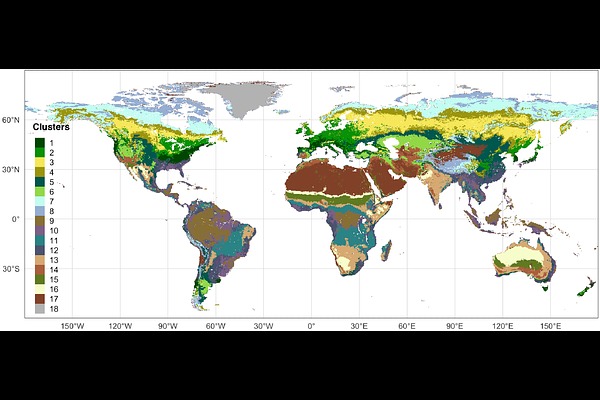
AbstractFuel availability and fuel dryness are consistently shown to be the primary drivers of wildfire intensity and burnt area. Here we hypothesise that differences in the timing of fuel build up and drying determine the optimal time for wildfire occurrence. We use gross primary production (GPP) as a measure of biomass production and hence fuel availability, and vapour pressure deficit (VPD) as a measure of fuel drying. We use the phase difference in the seasonal time course and magnitude of GPP and VPD to cluster regions that should therefore have distinct wildfire behaviour. We then show that each of the resultant clusters is distinctive in terms of one or more fire properties, specifically number of ignitions, burnt area, size, speed, duration, intensity, and length of the wildfire season. The emergence of distinct regimes as a function of two biophysical drivers reflects the fact that both vegetation and wildfire properties are a consequence of eco-evolutionary adaptions to environmental conditions. We then examine the degree to which human activities or vegetation properties modify these fire regimes within each of these clusters. Variability in GPP and VPD largely explains the within-cluster variation in fire properties. The type of vegetation cover has an influence on burnt area and carbon emissions in particular, while human activities are more important for fire properties such as size, rate of spread and duration largely through their influence of landscape fragmentation. Although both human activities and vegetation properties modify wildfire regimes, the ability to distinguish wildfire regimes using GPP and VPD alone emphasizes that land management, fire use and fire suppression are constrained by environmental conditions. This eco-evolutionary optimality approach to characterising wildfire regimes provides a basis for designing a simple fire model for Earth System modelling.