A Multiscale Model of Collective Decision-Making in Hybrid Aspen Tree Tissues Describes Bud-Dormancy Break

A Multiscale Model of Collective Decision-Making in Hybrid Aspen Tree Tissues Describes Bud-Dormancy Break
Dromiack, H.; Khanapurkar, S.; Phillips, R.; de Souza Moraes, T.; Davis, G.; Pandey, S.; Aryal, B.; Nair, A.; Bassel, G.; Bayer, E. E.; Bhalerao, R.; Walker, S.
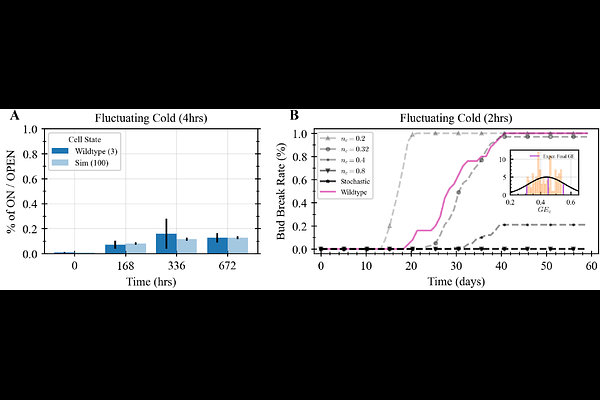
AbstractThe mechanisms underlying cellular coordination within tissues remain enigmatic. Most models focus on interactions between just two levels of organization - cell and tissue - and do not leverage data across deeper hierarchies that best represent living processes, with many spatial and temporal scales interacting. Integrating many scales, from molecular to cellular to tissular to organismal to populational, may be necessary to fully elucidate tissue function, especially in cases of sparse data at each level. Here, we investigate multiscale, robust regulation of tissue-level decision-making, using experimental studies of cold induced dormancy release in terminal buds of hybrid aspen trees as our case study. We develop a network model of terminal bud meristematic tissue, incorporating expression data from a key cold induced regulator gene, FLOWERING LOCUS T (FT1), which controls bud dormancy release, combined with data on variability in cell-to-cell communication controlled by FT1 mediated regulation of plasmodesmata. The model can explain dormancy breaking under constant temperature, but not variable temperature. We introduce constraints from organismal-level data and show how the presence of coordinated cellular interactions within individual plant tissues is necessary to reproduce data of population-level statistics. Our findings demonstrate how mechanisms of tissue function may be better constrained when data are used across more scales. They also hint at potential tantalizing new insights such as how tissue function might not be solely dictated bottom-up from molecular interactions, but also top-down from constraints imposed by the organismal and population context. Both implications illustrate the critical importance of incorporating cross-scale information processing in modeling biological decision-making.