A four-population model of Diaphorina citri and Tamarixia radiata with citrus flushing dynamics and impulsive parasitoid releases

A four-population model of Diaphorina citri and Tamarixia radiata with citrus flushing dynamics and impulsive parasitoid releases
Rodriguez-Falcon, S.; Arias-Castro, H.; Galeano, J.; Stucchi, L.
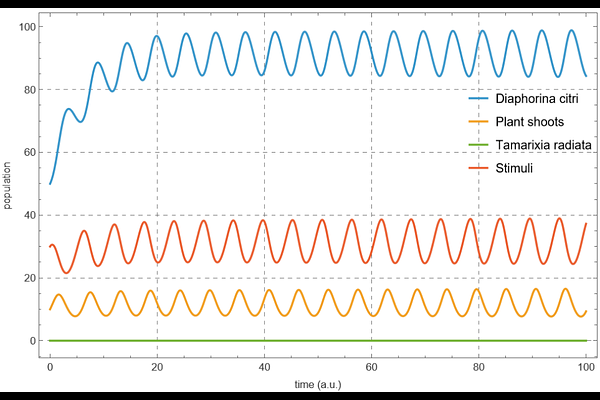
AbstractDiaphorina citri is the primary vector of Huanglongbing (HLB), a devastating disease that affects global citrus production. Effective biological control using the parasitoid Tamarixia radiata represents a sustainable alternative to chemical insecticides, but its efficacy depends heavily on environmental variables and resource availability. In this work, we develop a four-population mathematical model to analyze the dynamics of D. citri in the presence of T. radiata, a known parasitoid. Our model incorporates the cyclical and periodic behavior of citrus flushing (new shoots), providing a realistic representation of resource-limited dynamics as observed in field conditions. Through comparative simulations of three scenarios, without parasitoid, a single initial introduction, and periodic augmentative releases, we characterize and compare the impact of T. radiata as a biological control agent. Our results show that periodic releases maintain pest suppression, whereas a single introduction only delays pest recovery. By aligning theoretical modeling with ecological reality, this framework supports the role of T. radiata in pest suppression and provides a baseline for future work on optimal and cost-effective release strategies.