Coated Bacterial Enzymes: A one-step approach for enzymatic purification and immobilization

Coated Bacterial Enzymes: A one-step approach for enzymatic purification and immobilization
Ramirez Gutierrez, A. C.; Harguindeguy, I.; Homse, M. S.; Sabetta, A. E.; Cavalitto, S. F.; Ortiz, G. E.
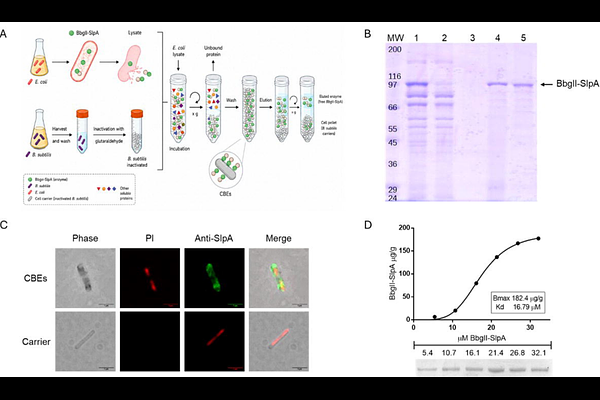
AbstractThe purification of industrial enzymes typically relies on costly, multi-step chromatographic protocols. To address this, we developed a novel platform termed Coated Bacterial Enzymes (CBEs), which enables one-step purification and immobilization of recombinant proteins fused to the SlpA cell wall binding domain. As a proof of concept, we used a {beta}-galactosidase from Bifidobacterium bifidum of dairy relevance. The chimeric enzyme BbgII-SlpA was expressed in Escherichia coli and captured from crude lysate onto glutaraldehyde-inactivated Bacillus subtilis cells via SlpA domain. Binding was characterized by a dissociation constant (Kd) of 16.2 {micro}M and maximum binding capacity (Bmax) of 144 {micro}mol/g. The resulting CBE biocatalyst exhibited optimal activity at pH 6.0 for ONPG and lactose, with a broader pH profile than the free enzyme. Optimal temperatures were 60 {degrees}C for ONPG and 50 {degrees}C for lactose, and CBE retained >80% activity after 390 min at 45 {degrees}C, compared to 20% for the free enzyme. Catalytic efficiencies (kcat/Km) were 2.62 x10⁶ M-1{middle dot}s-1 for ONPG and 4.40 x10² M-1{middle dot}s-1 for lactose. Moreover, CBE showed improved tolerance to cations such as Ca2+ and Fe2+. These results suggest that the CBE platform offers a cost-effective alternative for producing high-purity, immobilized enzymes for diverse industrial bioprocesses.