The limits of information in precise regulation of early multicellular life cycles

The limits of information in precise regulation of early multicellular life cycles
Libby, E.; Isaksson, H.; Ratcliff, W.
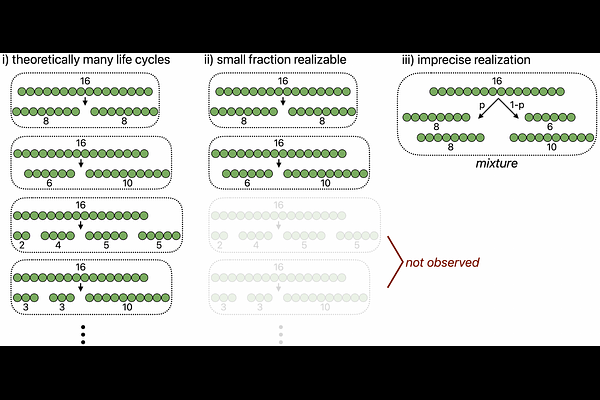
AbstractA key step in the evolution of complex multicellularity is the emergence of regulated life cycles that coordinate growth and reproduction. One potential route toward regulation involves co-opting intrinsic information: cues generated by routine cellular activities such as aging or mechanical stress from growth. Here, we model the simplest form of multicellular organization, linear filaments, to investigate whether intrinsic information can be harnessed to produce regular multicellular life cycles. Based on our analyses, we find that these information sources face an inherent trade-off between flexibility and regularity. Some sources, such as mechanical stress, precisely regulate when reproduction occurs but generate only a single reproductive mode. Others, such as cell age, can in principle produce diverse life cycles but fail to generate any of them reliably. Combining information sources through simple genetic circuits reduces variance in some cases, but the range of achievable life cycles remains constrained. Together these results suggest that while intrinsic information may facilitate early multicellular evolution, there are significant limitations on the degree to which it can be harnessed to evolve tightly-regulated, flexible life cycles. Our work highlights the constraints faced by nascent multicellular organisms and the evolutionary innovations likely required for coordinated multicellular development.