Annexin A2 Regulates Surfactant Dysfunction During Injurious Ventilation.

Annexin A2 Regulates Surfactant Dysfunction During Injurious Ventilation.
Bentley, I. D.; Fritz, J.; Kapoor, A.; Hite, R. D.; Ghadiali, S. N.; Englert, J. A.
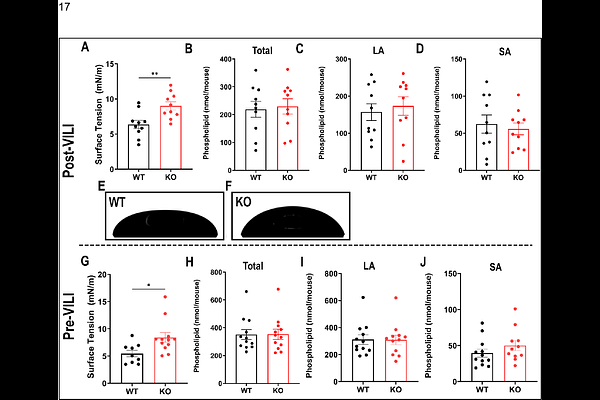
AbstractThe Acute Respiratory Distress Syndrome (ARDS) is a life-threatening cause of respiratory failure, and patients who develop ARDS frequently require mechanical ventilation, which puts them at risk of developing ventilator induced lung injury (VILI). Both VILI and ARDS can induce pulmonary surfactant dysfunction, but the mechanisms are not known. Here we report a novel role for a phospholipid binding protein, Annexin A2 (AnxA2), in the regulation of surfactant composition and function following injurious ventilation. Wild type and AnxA2-/- mice were subjected to injurious ventilation and we found that AnxA2-/- mice developed stiffer lungs following VILI that was not due to differences in barrier permeability or inflammation. Furthermore, we found that pulmonary surfactant from AnxA2-/- mice had reduced surface tension lowering properties and that this was due to a reduction in 1-palmitoyl-2-oleoylphosphatidylglycerol, or POPG. Computational analysis of surface tension-surface area plots from surfactant isolated from AnxA2-/- mice showed a defect in phase transitions during compression. In summary, Annexin A2 regulates surfactant function during injurious ventilation and may serve as a novel therapeutic target to prevent surfactant dysfunction in patients with ARDS who require mechanical ventilation.