β-cell NCK1 is reduced in type 2 diabetes, leading to inefficient β-cell UPR and insulin secretion and revealing sex-specific adaptation during metabolic stress

β-cell NCK1 is reduced in type 2 diabetes, leading to inefficient β-cell UPR and insulin secretion and revealing sex-specific adaptation during metabolic stress
Monteillet, L.; Jouvet, N.; Huet, R.; Touzot, J.; Grieco-St-Pierre, L.; Galipeau, M.; Clemence, S.; Schoumacher, M.; Courty, E.; Baldwin, C.; Paraskevas, S.; Estall, J. L.
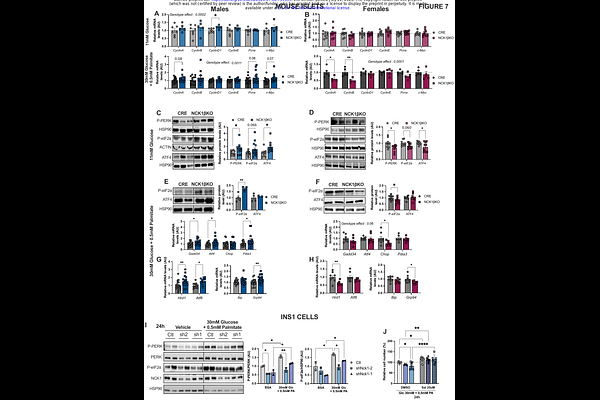
AbstractType 2 diabetes is characterized by failure of pancreatic {beta} cells to adapt insulin secretion to metabolic demand, due to impaired {beta} cell function and/or reduced {beta} cell mass. The unfolded protein response (UPR) is central to this adaptation by maintaining endoplasmic reticulum homeostasis and supporting insulin biosynthesis, secretion, proliferation, and survival. NCK1, is an adaptor protein that regulates diverse cellular processes, including insulin biosynthesis and UPR activation, positioning it at the crossroads of several processes essential for {beta} cell function. Moreover its silencing is reported to enhance adaptive PERK signaling and beta cell survival in vitro, suggesting that it could represent an important regulator of {beta} cell adaptation. Here, we explored this potential role for NCK1 using {beta} cell specific knockout mice (NCK1{beta}KO) and human islets of both sexes. NCK1 expression was positively regulated by glucose yet reduced in islets from individuals living with type 2 diabetes. Loss of {beta} cell NCK1 impaired insulin gene expression, insulin content, and glucose-stimulated insulin secretion in vitro, and disrupted UPR activation. In vivo, {beta} cell NCK1 deletion led to sex-dependent adaptation to maintain glucose homeostasis. Under high-fat/high-sucrose diet, both NCK1{beta} KO male and female mice increased pancreatic insulin content, but only males showed improved insulin secretion associated with islet expansion and {beta} cell proliferation. Females, in contrast, exhibited impaired insulin secretion despite preserved insulin stores, associated with increased numbers of small islets and altered PERK pathway activation. These findings identify NCK1 as a regulator of {beta} cell insulin synthesis, secretion, and UPR signaling, and reveal sex-specific adaptive mechanisms to {beta} cell stress. Reduced NCK1 in islets from people living type 2 diabetes may disrupt {beta} cell adaptation to metabolic stress and contribute to diabetes.