Comparative food-web analysis of bluefin tuna spawning habitats in the eastern Indian Ocean and Gulf of Mexico

Comparative food-web analysis of bluefin tuna spawning habitats in the eastern Indian Ocean and Gulf of Mexico
Stukel, M. R.; Landry, M. R.; Decima, M.; Fender, C. K.; Kranz, S. A.; Laiz-Carrion, R. L.; Malca, E.; QUINTANILLA, J. M.; Selph, K. E.; Swalethorp, R.; Yingling, N.
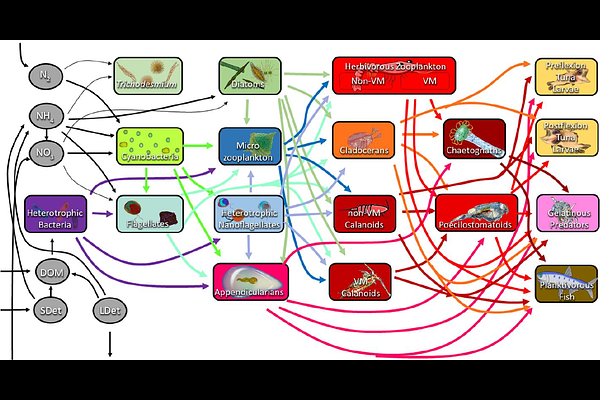
AbstractUsing linear inverse ecosystem modeling as a data assimilation tool, we compare spawning grounds of Atlantic and Southern Bluefin Tuna (ABT and SBT, respectively) based on results from field campaigns in the Gulf of Mexico (GoM) and eastern Indian Ocean off northwest Australia (Argo Basin). Both regions are warm, stratified, low-nutrient waters dominated by cyanobacteria (Prochlorococcus). Despite these similarities, the Argo Basin is more productive, with ~1.5X higher net primary production and nearly 2X higher production of top trophic levels in the model (tuna larvae, planktivorous fish, and predatory gelatinous zooplankton). Higher primary production in the Argo Basin is mainly driven by higher N2 fixation and storm mixing of new nutrients in the upper and lower euphotic zone, respectively. Increased ecosystem efficiency (secondary production of top trophic levels / primary production) results from differences in plankton food web organization. In the GoM, protistan zooplankton are the direct consumers of nearly all phytoplankton production. In contrast, higher rates of herbivory by crustaceans feeding on nanophytoplankton combines with a higher impact of appendicularians on cyanobacteria to convert plankton production into larval tuna prey more efficiently in the Argo Basin. Despite similarities in the proportions of phytoplankton production mediated by cyanobacteria and other picoplankton in both systems, food web pathways to larval tuna and other planktivorous fish are substantially shorter in the Argo Basin. Our results highlight the impact of distinct zooplankton ecological niches on ecosystem efficiency and suggest a need for better inclusion of plankton food-web structure in models simulating climate impacts on fisheries production.