Enterococcus faecalis is involved in the progression of the early stages of latent chronic pancreatitis surrounding pancreatic cancer tissue

Enterococcus faecalis is involved in the progression of the early stages of latent chronic pancreatitis surrounding pancreatic cancer tissue
Takamatsu, S.; Nishikori, K.; Shimosaka, M.; Uemura, R.; Ishida, Y.; Sugawa, R.; Matsumoto, M.; Ogata, A.; Sakon, D.; Inui, M.; Yamada, D.; Akita, H.; Kondo, J.; Kodama, T.; Kamada, Y.; Eguchi, H.; Morii, E.; Miyoshi, E.
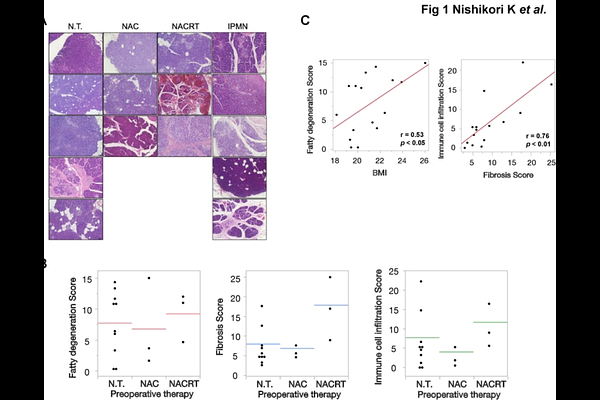
Abstract(Objective) In our previous research, we identified latent chronic pancreatitis in the normal tissue surrounding pancreatic cancer. We also discovered the presence of Enterococcus faecalis (E. faecalis), a type of intestinal bacterium, in the pancreatic fluid and tissue of pancreatic cancer patients, suggesting it may be one of the factors contributing to the development of latent chronic pancreatitis. In this study, we performed pathological analyses to investigate its characteristics and investigate a possibility of E. faecalis infection. (Methods) Pathological analyses were performed, using 16 cases of pancreatic cancer and intraductal papillary mucinous neoplasia (IPMN) involving lesions in the pancreas tail. The involvement of E. faecalis was investigated with immunohistochemical analysis and serological methods. (Results) All cases exhibited inflammatory changes in pancreatic tissue without a clinical diagnosis of chronic pancreatitis, along with macrophage infiltration. These changes did not significantly differ according to preoperative treatment. DNA encoding E. faecalis 16s ribosomal RNA was detected in many cases, however, a positive immunostaining to E. faecalis was observed in only a few cases. Serum capsular polysaccharide (CPS) antibody levels exceeding the mean values were observed in patients with established chronic pancreatitis, while the level was not correlated with E. faecalis immunostaining. (Conclusion) These results suggest the E. faecalis infection is involved in the early stage of the progression of chronic latent pancreatitis and the diagnostic technology incorporating novel multi-biomarkers may be useful for identifying high-risk individuals for future pancreatic cancer development.