Early life adversity shapes adult behavior in a free-ranging primate

Early life adversity shapes adult behavior in a free-ranging primate
Patterson, S. K.; Negron-Del Valle, J. E.; Phillips, D.; Ruiz-Lambides, A.; Cayo Biobank Research Unit, ; Snyder-Mackler, N.; Brent, L. J. N.; Higham, J. P.
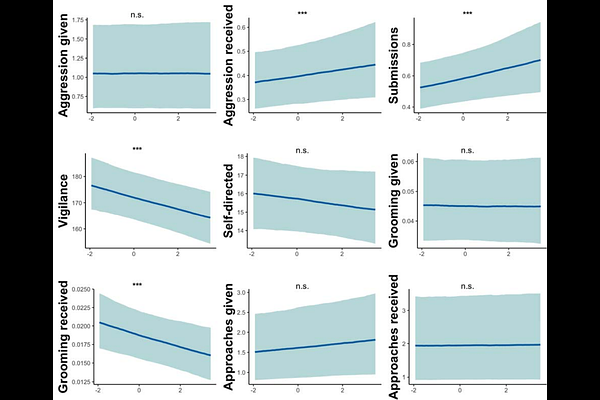
AbstractEarly life adversity (ELA) causes lasting psychological and behavioral consequences in humans, with parallel stress and fear responses observed in captive animals. How naturally occurring ELA shapes behavior in non-captive animals remains poorly understood. Investigating these effects across socioecological environments is important for identifying the evolutionary pressures shaping early life sensitivities, and determining whether these behavioral syndromes have deep evolutionary roots. Here, we tested the effects of eight forms of ELA on adult behavior using a large dataset (N=313 males, 346 females) from a free-ranging population of rhesus macaques (Macaca mulatta). We measured adult behaviors indicative of stress and the tenor of social interactions, including agonism, vigilance, self-directed behaviors, and affiliation. Individuals exposed to more ELA received more aggression and less grooming, were more submissive, and were less vigilant. While high status buffered the effects of ELA on grooming, it amplified effects on aggression. Our findings demonstrate that in a large sample of a free-ranging primate, early life environments impact behavior into adulthood. While some behaviors are consistent with patterns in humans and captive animals, suggesting an evolutionarily conserved ELA syndrome, other findings add new insights into the various ways individuals interact with their environment as a function of ELA.