Repeatability of adaptation in interacting species

Repeatability of adaptation in interacting species
Hablützel, L.; MacPherson, A.; Bank, C.
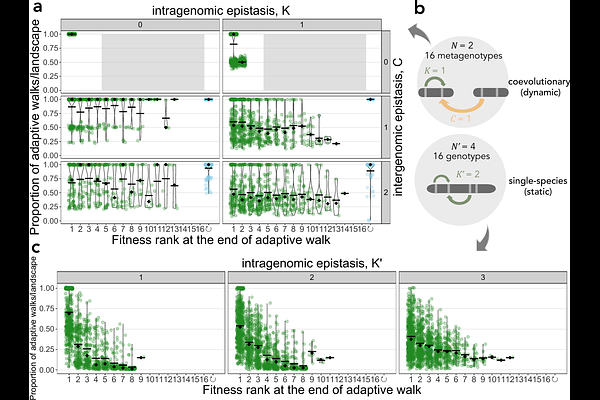
AbstractIn many systems, mutations can have background-dependent fitness effects due to genetic interactions between loci within a genome (intragenomic epistasis). In some cases, such as when species are coevolving, genetic interactions between loci can span across species; this is described as intergenomic epistasis. It is known that intragenomic epistasis can make adaptation more repeatable by constraining accessible mutational paths. Here, we investigate whether intergenomic epistasis leads to the same pattern of increased repeatability and how repeatability is influenced by the interplay of intra- and intergenomic epistasis. For this, we model a two-species system in which the fitness of a species depends on the combination of genotypes that are present in both species. We implement this system using an NKC model, which allows us to construct coevolutionary fitness landscapes on which we simulate adaptation by means of mutations in both species. To quantify the repeatability of adaptation, we track the realised endpoints of adaptive walks and record the distribution of fitnesses of the focal and partner species at these evolutionary endpoints. We find that intergenomic epistasis creates highly repeatable patterns of adaptation that depend on the underlying shape of the coevolutionary landscapes. The patterns of repeatability deviate from expectations based on intragenomic epistasis due to fitness trade-offs between species, which can lead to cycling and large co-evolutionary fitness loads.