Turning of (Ph)age: Expanding the therapeutic potential of our viral allies

Turning of (Ph)age: Expanding the therapeutic potential of our viral allies
Ababi, M.; Tridgett, M.; Castado, C.; Blais, N.; Giannini, S.; Jaramillo, A.
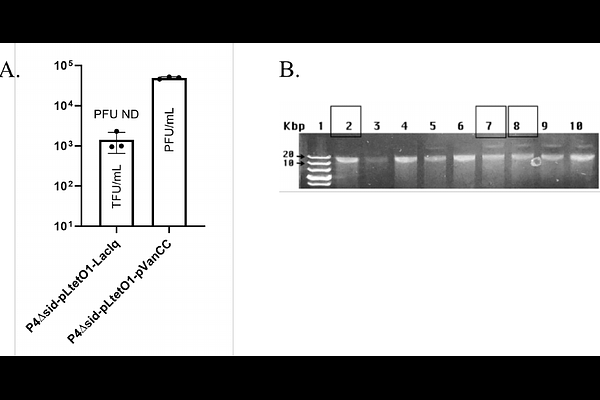
AbstractNovel strategies for treating bacterial infections are needed to combat the growing threat of antibiotic resistance. Here we sought to engineer and produce phage-like particles to either harness the microbiome to secrete therapeutics or to hijack pathogenic bacteria for treatment and prevention of disease. For this, we used the P2/P4 system to design, produce and test P4 phage-mediated single- and dual-action antimicrobial prototypes. Upon successful completion of the in vitro proof of concept experiments, we focused on optimizing early-stage bioprocessing for in vivo studies, leading to 10^11 plaque forming units (PFU) per mL and 0.25 endotoxin units (EU) per 10^9 PFU. We also challenged the P4 viral vector packaging limit by deleting the sid gene to package the payload into P2-sized capsids (~25.8 kb cargo capacity). Importantly, repressing the therapeutic payload during the production of particles improved viral titers about 2 logs, maintained viral payload sequence integrity and improved post-transduction functional activity. Altogether, this study demonstrates the potential of novel phage-based antimicrobials to go beyond elimination of bacteria. The in vitro optimized P2/P4 system constitutes a promising platform technology for in vivo evaluations of targeted antimicrobial candidates paving the way for future antimicrobial research in animal models of infection.