TRACKING EVOLUTIONARY COSTS OF IMMUNE ADAPTATION AGAINST SINGLE VERSUS COINFECTING PATHOGENS

TRACKING EVOLUTIONARY COSTS OF IMMUNE ADAPTATION AGAINST SINGLE VERSUS COINFECTING PATHOGENS
Seal, S.; Tiwari, P.; Ghosh, K.; Debnath, P.; Kumari, N.; Khan, I.
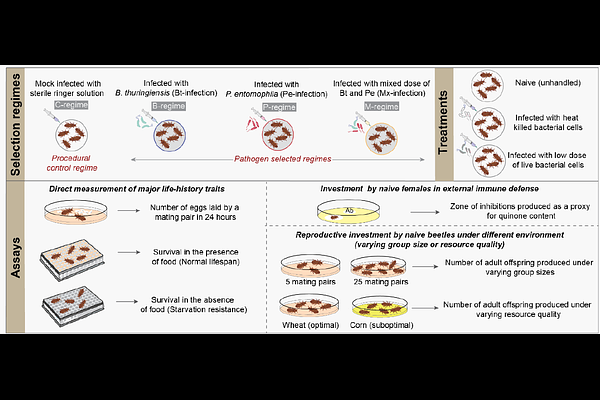
AbstractImmunity against pathogens is costly and can adversely affect fitness through resource allocation or physiological trade-offs. Infection by multiple pathogens may further worsen the effects if hosts require the activation of multiple immune responses, which in turn can elevate the overall immunological costs. Poor body condition and stressful environments can also exacerbate these trade-offs. In this study, we experimentally tested these possibilities using Tribolium castaneum populations that were evolving against either a single or a set of coinfecting bacterial pathogens. Contrary to our expectations, none of these evolved beetles showed any measurable trade-offs between pathogen resistance vs major fitness traits, such as reproduction or lifespan. Instead, they appeared to increase reproductive success and resistance to starvation, suggesting improved body condition that could mask underlying fitness costs. However, evolved beetles showed reduced quinone production, an externally secreted antimicrobial defence, indicating trade-offs between internal vs external immunity. Finally, we identified reproductive costs only under limited resource availability, but not under suboptimal resource quality, suggesting that trade-offs can be highly condition-dependent. Overall, this study provides a unique comparison across pathogens and infection types, highlighting the importance of analysing variation in life-history traits within relevant ecological contexts to understand fitness costs of evolving immunity.