A CURE for synthetic regulation of gene expression: Rapid screening of guide RNA efficacy as a framework for enabling undergraduate research in plant synthetic biology

A CURE for synthetic regulation of gene expression: Rapid screening of guide RNA efficacy as a framework for enabling undergraduate research in plant synthetic biology
Bull, T.; Carlsen, L.; Hoglund, N.; Blarr, J.; Ciernia, M.; Daughtrey, H.; Gulnac, K.; Kathan, Z.; Labovitz, B.; Lonergan, R.; McDermott, M.; Medina, A.; Mikol, Z.; Miller, Z.; Prahl, K.; Rifai, C.; Schrems, E.; Shinkawa, F.; Summerfield, J.; Thevarajah, E.; Wagner, S.; Zimmerman, T.; Khakhar, A.
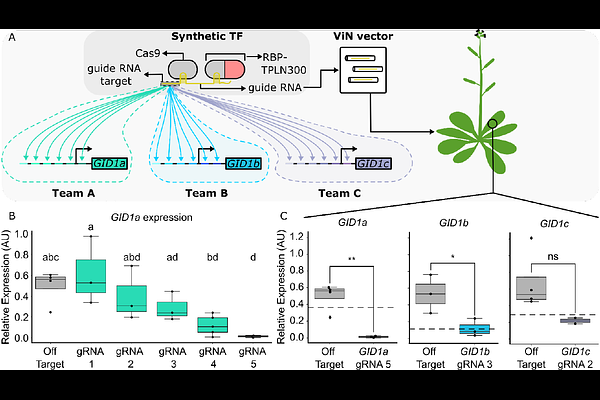
AbstractCourse-based Undergraduate Research Experiences (CUREs) have emerged as a transformative approach to science education, expanding access to authentic research opportunities beyond the traditional undergraduate research assistant (URA) training. By embedding research into a curriculum, CUREs engage a broad and diverse population of students in a classroom environment that emphasizes experimental design, data analysis, and scientific communication. However, this has been difficult to develop for fields such as plant synthetic biology due to the long timescales of plant transformation. One avenue around this problem is to utilize a recent innovation that enables high throughput and rapid screening of gRNA efficacy by leveraging viral-based delivery of guide RNAs (gRNAs). In this work, we develop and validate a CURE with undergraduate students at Colorado State University (CSU). Students worked in teams to design and test efficacy of gRNAs targeting a Cas9-based transcriptional repressor to different regions of the promoters of the three GIBBERELLIN INSENSITIVE 1 genes (GID1a, GID1b, and GID1c) in Arabidopsis thaliana. Over the semester, students generated and analyzed gene expression data to understand the efficiency of twelve new gRNAs. We further validated CURE student-identified gRNAs with an undergraduate research assistant (URA) that assessed target gene expression and phenotypic outcomes in stable transgenic lines expressing SynTF constructs with the strongest gRNAs from the class. We further describe the curriculum structure to facilitate adoption at other institutions and present student-generated datasets demonstrating the utility of ViN-based screening for identifying effective SynTF gRNAs for plant functional genomics and engineering.