Identification of Siderophores with Unexpected Antibacterial Properties from Actinoplanes teichomyceticus

Identification of Siderophores with Unexpected Antibacterial Properties from Actinoplanes teichomyceticus
Oyedele, A. S.; Jana, S.; Jeon, K.; Vazrala, N.; Stec, D. F.; Kim, K.; Sulikowski, G. A.; Walker, A.
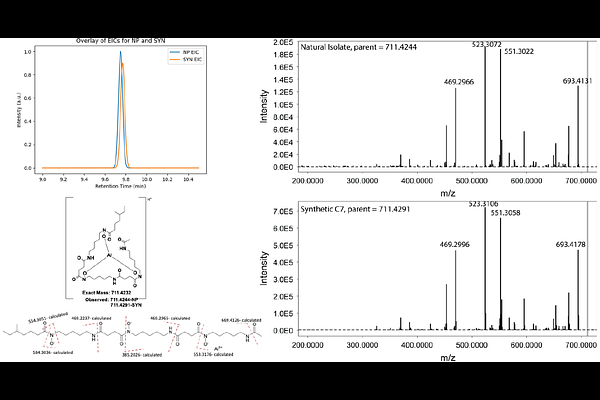
AbstractActinoplanes teichomyceticus is a well-established producer of bioactive secondary metabolites, including the glycopeptide antibiotic teicoplanin. Although its antibiotic biosynthetic capacity has been extensively investigated, its siderophore diversity and any additional biological functions of these iron-chelating metabolites remain comparatively underexplored. We identified a reproducibly bioactive, teicoplanin-independent fraction that inhibited Bacillus spizizenii. Molecular networking applied to this fraction identified hydroxamate ferrioxamine and desferrioxamine-type siderophores as the dominant metabolites, including acylated analogs detected as Al3+- and Fe3+-chelated species. Robust siderophore secretion was confirmed by the CAS assay. Notably, siderophore-enriched fractions exhibited selective antibacterial activity against Gram-positive bacteria, with minimum inhibitory concentrations of approximately 16 g/mL against B. spizizenii and partial inhibition of Staphylococcus aureus, while no activity was observed against Escherichia coli. Synthetic C7 and C9 acyl-desferrioxamine analogs showed enhanced antibacterial activity upon Al3+ chelation, indicating a metal-dependent bioactivity. These findings reveal an unexpected antibacterial role for ferrioxamine-type siderophores produced by A. teichomyceticus, extending their function beyond iron acquisition, possibly through a 'Trojan horse' (or 'Trojan metal') mechanism.