In silico identification and deorphanisation of an allatostatin C GPCR system in the cephalopod Octopus vulgaris reveals two receptors with distinct potency

In silico identification and deorphanisation of an allatostatin C GPCR system in the cephalopod Octopus vulgaris reveals two receptors with distinct potency
Pieroni, E. M.; Dillon, J.; O'Connor, V.; Holden-Dye, L. M.; Imperadore, P.; Fiorito, G.; Yanez-Guerra, L. A.
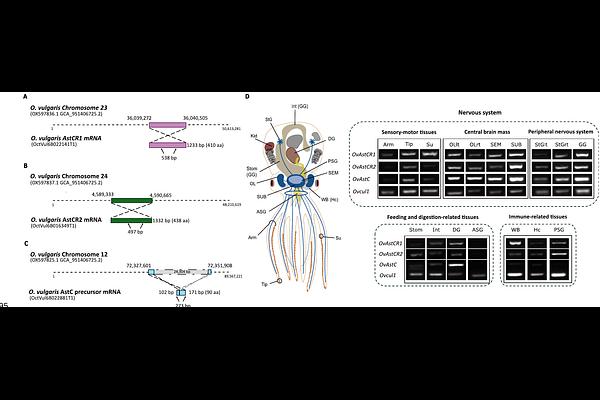
AbstractNeuropeptide signalling is transversally important in all living animals as it constitutes the basis of cellular communication. The investigation of the functional roles of peptide signalling represents an important route to understanding evolution of specific physiological traits and behaviours in metazoans. Allatostatins and their cognate receptors are classically defined as invertebrate neuropeptide hormones. Among these, allatostatin C was firstly associated with insect development. However, accumulating evidence recognises the presence of allatostatin C as a conserved signalling molecule across all invertebrate lineages, with reported functions spanning from regulation of feeding and digestion to immune responses and modulation of core nociception. Here we combined in silico and experimental approaches to reveal the interacting molecular determinants of the allatostatin C signalling in the cephalopod Octopus vulgaris, a scientifically and culturally interesting invertebrate for its centralised nervous system, capable of top-down modulation of complex behaviours. This resolved a single prepropeptide encompassing allatostatin C peptide (OvAstC), whose conserved mature form (AVITACYFQAVSCY) was shown to differentially activate two identified cognate receptors (OvAstCR1 and OvAstCR2) when heterologously expressed in the recombinant system HEK293G5A. PCR analysis carried out in O. vulgaris tissues, showed a broad distribution of OvAstC and OvAstCRs. This wide expression across nervous, immune and digestive tissues is consistent with a pleiotropic role of this peptidergic system. Together, the opioid/somatostatin-related phylogenetic placement of OvAstCRs and the broad expression of OvAstC components in nervous and sensory tissues nominate this pathway as a candidate for neuromodulatory control of sensory processing, including nociception, with potential welfare relevance in cephalopods.