Exploring Warming Effects on lower food-web dynamics in the plankton of the River Elbe Estuarine Ecosystem in summer: Insights from a Mesocosm Experiment

Exploring Warming Effects on lower food-web dynamics in the plankton of the River Elbe Estuarine Ecosystem in summer: Insights from a Mesocosm Experiment
Listmann, L.; Golebiowska, J.; Lambrecht, M.; Palash, S. A.; Rueda, D. N. P.; Grossart, H.-P.; Malzahn, A.; Schaum, E.; Aberle, N.
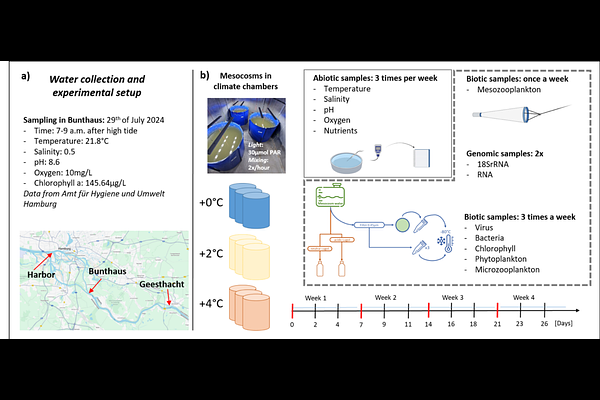
AbstractUnderstanding how warming alters estuarine plankton communities is essential for predicting future changes in biodiversity and ecosystem functioning. We conducted a four-week indoor mesocosm experiment using natural summer plankton from the Elbe River to examine the effects of warming (+2 C and +4 C) on abiotic conditions and responses of the plankton community. In this study, oxygen concentrations, primary producer biomass (chlorophyll a, microphytoplankton) and microzooplankton abundances declined sharply during the first 10 days across all treatments while mesozooplankton abundances increased. This suggests a strong top-down control by mesozooplankton on lower trophic levels across all temperature treatments. Primary producers biomass and oxygen concentrations recovered after an initial decline, however to lower levels compared to the onset of the experiment while micro- and mesozooplankton remained low during the second half of the experiment. Nutrient dynamics indicated progressive remineralization, with increasing ammonium, NOx, and silicate concentrations, while phosphate concentrations remained low throughout the experiment. Complementary DNA and RNA metabarcoding revealed similar community turnover over time in all treatments and temperature effects became only pronounced at the end of the experiment. Overall, warming effects were subtle relative to the strong internal trophic dynamics likely caused by the artificial mesocosm setup. Our findings of changes in plankton community dynamics indicate that biotic interactions, changes in trophic diversity and other environmental factors, i.e. oxygen concentrations are likely the drivers of this estuarine system rather than warming alone.