Development and assessment of tailored illustrations to enhance community understandings of genetics topics

Development and assessment of tailored illustrations to enhance community understandings of genetics topics
Arner, A. M.; McCabe, T. C.; Seyler, A.; Zamri, S. N.; A/P Tan Boon Huat, T. B. T.; Tam, K. L.; Kinyua, P.; John, E.; Ngoci Njeru, S.; Lim, Y. A.; Gurven, M.; Nicholas, C.; Ayroles, J.; Venkataraman, V. v.; Kraft, T. S.; Wallace, I. J.; Lea, A. J.
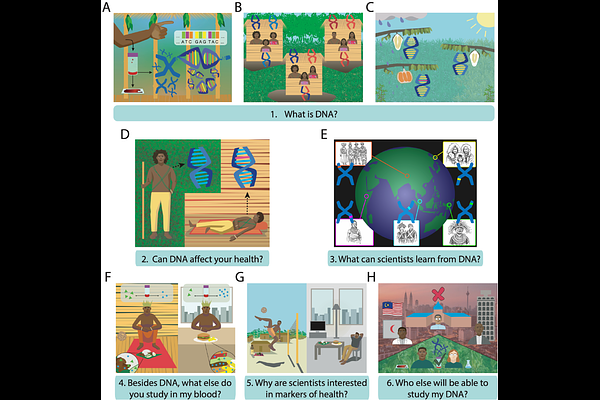
AbstractObjectives: Effective communication about genetics concepts is essential for collaborative anthropological genetics research. However, communication can be challenging because many ideas are abstract and may be especially unfamiliar to communities with limited access to formal education. Indeed, there are no widely adopted models for communicating such information, nor a clear understanding of the social factors that may shape participant engagement. Here, we conducted a qualitative and quantitative, community-driven study to understand how illustrations can be useful to support concept sharing with two Indigenous groups: the Orang Asli of Peninsular Malaysia and the Turkana of Kenya. Methods: We used a two phase approach to create and evaluate how illustrations can bolster communication about genetics concepts. First, we created images illustrating answers to frequently asked questions about genetics, iteratively updating the illustrations based on participant feedback. Second, we conducted 92 interviews to evaluate the effectiveness of the finalized illustrations. Finally, we analyzed the interview data using thematic analyses, multivariable modeling, and multiple correspondence analyses to identify patterns in participant understanding and feedback, including age, sex, market integration, and schooling. Results: Participants reported high interest in genetics research (92%) and broadly positive perceptions of the illustrations. Familiar, locally-grounded imagery was preferred and associated with greater perceived clarity, while more technical illustrations were more frequently reported as confusing. Quantitative analyses showed strong internal consistency across measures of engagement and understanding, with modest variation by degree of market-integration, schooling, and sex. Discussion: Our findings demonstrate that community-specific visualizations, co-developed through iterative feedback, can effectively support engagement with genetics research in participant communities.