Warming amplifies short-term responses to disturbance in lake food webs

Warming amplifies short-term responses to disturbance in lake food webs
Clemente, G. V.; Bradshaw, C. J. A.; Strona, G.
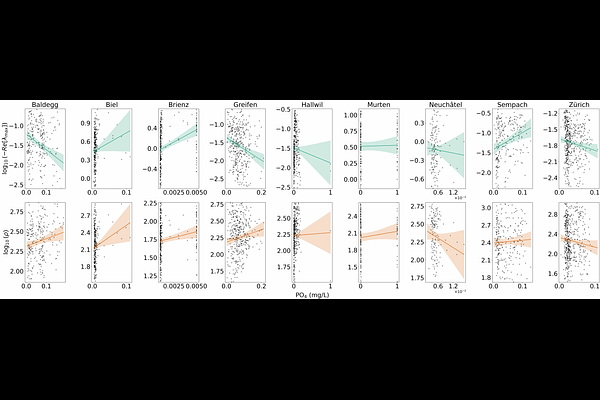
AbstractEcological communities can exhibit transient amplification after disturbance even if asymptotically stable, yet how environmental change reshapes these short-term responses in real food webs remains unclear. We combined four decades of monthly plankton observations from nine Swiss lakes with a food-web model to quantify effects of warming and oligotrophication on two transient properties: reactivity (instantaneous sensitivity to small disturbances) and the time to peak response (tmax). Across lakes, community states lie in an asymptotically stable yet reactive regime. Warmer conditions consistently increased reactivity and lengthened tmax; after accounting for oligotrophication, a 1 {degrees}C rise in mean temperature corresponded to ~ 10 higher reactivity on average. Linking month-to-month variation in transient metrics to guild biomass showed that reactivity covaried strongly with consumer biomass, especially large herbivores, whereas tmax was most associated with predator biomass, a pattern consistent with metabolic-scaling predictions from thermal ecology. The central warming-reactivity association was preserved when we made the bioenergetic parameters themselves temperature-dependent through Boltzmann-Arrhenius scaling. Warming therefore systematically boosted transient sensitivity in these lake food webs via shifts in consumer and predator biomass.