Beyond the Panglossian paradigm: adaptation, constraint, and anuran functional trait evolution.

Beyond the Panglossian paradigm: adaptation, constraint, and anuran functional trait evolution.
Jones, M.; Slater, G. J.
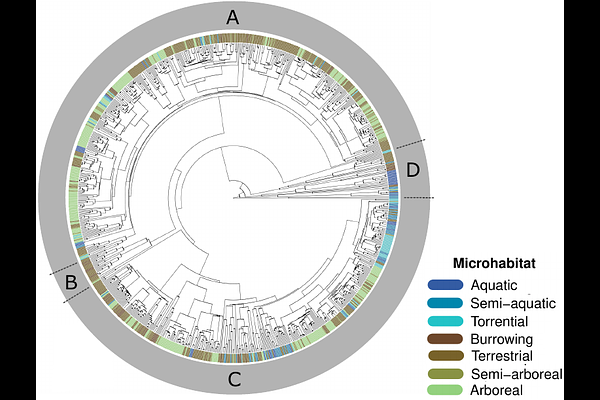
AbstractRecognizing patterns in functional trait evolution is a necessary step in testing macroevolutionary questions. Quantification of these patterns and interpretation of their generative processes relies on an ever-expanding suite of comparative approaches, but current methods oversimplify the process-to-pattern mapping. This simplification may promote binary classifications of patterns and their drivers, such as "adaptive versus non-adaptive" or "constrained versus unconstrained". A potentially more robust and evolutionarily informative alternative is to fit an expanded suite of evolutionary models at different levels of taxonomic or ecological resolution to reveal how evolutionary drivers imprint simultaneously on observed patterns of trait evolution. Here, we perform a clade-wide analysis of functional trait evolution across Anura (frogs and toads). Focusing on three functionally important traits, we quantify the relative fit of random, directional, and bounded models at the intra- and inter-microhabitat levels to explore how changes in trait function across microhabitats translate into different evolutionary regimes. We recover heterogeneous regime-level distributions of model support that imply complex underlying evolutionary dynamics, while also revealing methodological biases and model identifiability issues. These findings underscore the need to develop more robust tools for evolutionary model fitting and advance beyond binary frameworks for interpreting evolutionary processes.