Hormonal stimulation induces broader decidualization responses than cAMP alone in 3D human endometrial organoids

Hormonal stimulation induces broader decidualization responses than cAMP alone in 3D human endometrial organoids
Liu, S.; Zhang, J.; Zhan, T.; Zhang, Q.; Douglas, N.; Ye, X.; Xiao, S.
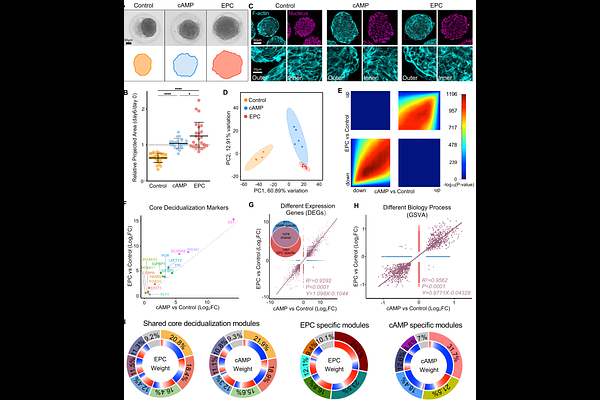
AbstractThe human endometrium undergoes cyclic, hormone-driven remodeling that establishes a transient window of receptivity required for embryo implantation, placentation, and maintenance of pregnancy. Decidualization of endometrial stromal cells is a central component of this process and can be induced in vitro using cAMP alone or in combination with ovarian steroid hormones (EPC: estradiol, progesterone, and cAMP). Although cAMP activates the core decidual transcriptional program, whether hormone supplementation induces a more physiologically relevant response remains unclear, particularly in 3D endometrial organoid (Endo-organoid) models which have emerged as a new alternative methodology (NAM). Here, we compared morphological and transcriptomic responses of human endometrial stromal cell-derived Endo-organoids undergoing decidualization induced by cAMP or EPC stimulation. EPC-treated Endo-organoids exhibited enhanced structural remodeling and more advanced morphological transformation compared with cAMP-treated organoids. RNA-seq analysis revealed substantial overlap in canonical decidual gene expression between the two conditions, but EPC induced broader transcriptional and pathway-level changes, including enrichment of metabolic, stress-response, and differentiation-related processes. Together, these findings demonstrate that while cAMP activates the core decidual program, EPC elicits a broader and more physiologically relevant decidualization response in 3D human Endo-organoids, providing guidance for optimizing Endo-organoids to study endometrial receptivity, implantation, and early pregnancy success.