Ungulate conservation: Lessons from experimental white-lipped peccary management in agricultural-natural landscape mosaics of the Brazilian Cerrado

Ungulate conservation: Lessons from experimental white-lipped peccary management in agricultural-natural landscape mosaics of the Brazilian Cerrado
Painkow Neto, E.; Silvius, K. M.; Barquero, G.; Neves, D. C.; Fragoso, J. M. V.
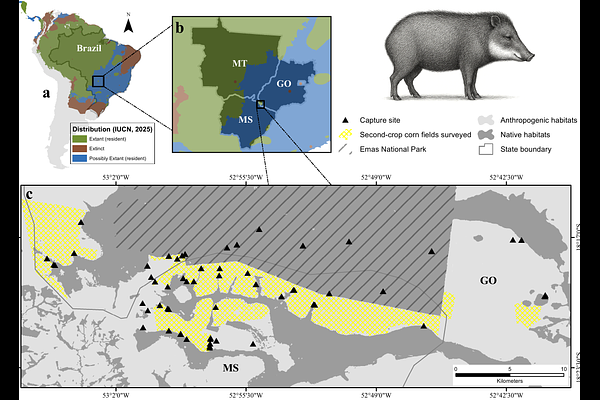
AbstractAnimal population control is widely used to mitigate conflicts between wildlife and agriculture worldwide. Structured, monitored removals are rare in South America, however, and their consequences for wildlife populations as well as their effectiveness in reducing crop damage are little understood. Using eight years of data from an experimental white-lipped peccary management program in an agricultural mosaic in the Brazilian Cerrado biome, we assess how structured, non-lethal removals affect both peccary demography and second-crop corn damage. Leslie removal models based on 6,619 captured individuals indicated that cumulative removals to approximately 85% of the initial population strongly reduced peccary abundance, with limited demographic compensation despite fluctuations in reproductive output. Corn crop damage, quantified with satellite imagery, declined over time and was correlated with peccary population size. Interannual variation in population growth and juvenile recruitment was poorly explained by climate, fire, or landscape composition. Source-sink dynamics likely play a role in maintaining healthy populations at the regional scale. Together, these results demonstrate that sustained and monitored ungulate removals can reliably reduce population size and agricultural damage, supporting coexistence between wildlife and food crop production in human-dominated tropical landscapes.