Achieving spatial multi-omics integration from unaligned serial sections with DIME

Achieving spatial multi-omics integration from unaligned serial sections with DIME
Sun, P.; Huang, X.; Mou, T.; Zheng, X.
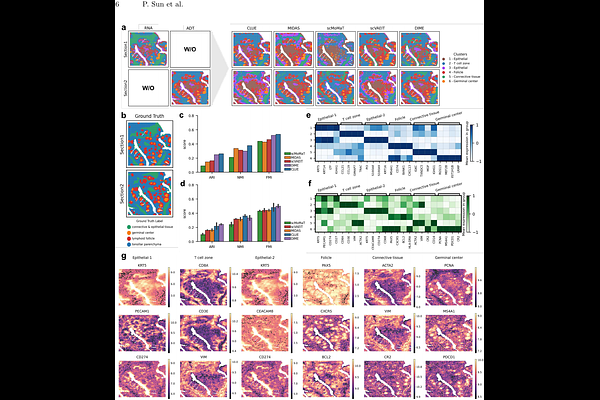
AbstractLearning integrated representations from spatial multi-omics data is a fundamental challenge, particularly in the context of "diagonal integration", where data are collected from serial tissue sections across distinct omics modalities. Existing methods typically rely on the assumption of feature intersection to construct a common metric space, a prerequisite that is absent in this setting. To address this, we propose the Diagonal Integration Model for Spatial Multi-omics Embedding (DIME), a novel deep learning framework that couples a graph contrastive learning objective with cross-modal correspondence. This global correspondence is established by a hybrid alignment strategy: it first anchors high-confidence regions using Coherent Point Drift with Linear Assignment, and then extends matching to the entire tissue manifold via an Optimal Transport formulation encoding relative geodesic distances. Designed to balance inter-modal guidance with intra-modal structure preservation, DIME enables robust fusion and denoising. Experiments on simulated and real human tissue datasets demonstrate DIME's superior robustness and versatility, where its learned representations achieve outstanding clustering accuracy and unlock the identification of biologically meaningful spatial domains.