Coevolution of Codependent Hosts and Symbionts

Coevolution of Codependent Hosts and Symbionts
Lynch, M.; Joshi, K.; Casanova, A. G.
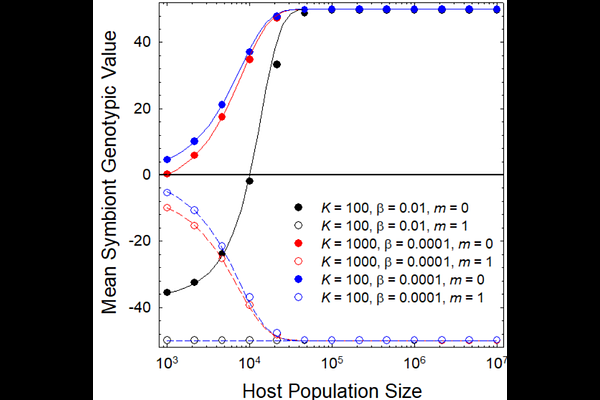
AbstractMany endosymbioses in eukaryotes superficially appear to be beneficial to both participants. However, there is little direct evidence for this, and symbioses naturally set up conditions in which each member of the pair is under selection to extract resources from the other. Ultimately, the endosymbiont either evolves to be in conflict with the interests of the host or to act cooperatively with the host contrary to its own best interests. Focusing on obligate symbioses, we develop theory to clarify the population-genetic conditions favoring the alternative outcomes. The balance is usually tipped in favor of exploitation by the symbiont, particularly when the number of symbionts within host cells is high, selection is strong on symbionts relative to hosts, there is horizontal transfer of symbionts, and/or the symbionts have accelerated mutation rates or turnover times. If the symbiont conditions the host-cell biology to enhance within-host population sizes, selection for selfish symbionts will be further enhanced by the diminished level of within-host drift. Although the host evolves in parallel to exploit resources from the endosymbiont, the net result is often a stalemate in which the host is no better off than prior to host-symbiont coevolution. Strict vertical inheritance can result in an evolutionary alignment of interests of the endosymbiont and the host, as this minimizes the possibility of within-host selection, but even here there is a critical host population size below which the symbiont evolves to exploit the host. These results suggest that the evolutionary enslavement of a symbiont to benefit a host species requires a narrow mix of population-biological features of both participants.