NG2-targeting macrophages inhibit 3D invasion of patient-derived glioblastoma spheroids

NG2-targeting macrophages inhibit 3D invasion of patient-derived glioblastoma spheroids
Kurudza, E.; Varady, S. R. S.; Greiner, D.; Marvin, J. E.; Ptacek, A.; Rodriguez, M.; Mishra, A. K.; He, G.; Dotti, G.; Colman, H.; Reeves, M. Q.; Montell, D. J.; Cheshier, S. H.; Roh-Johnson, M.
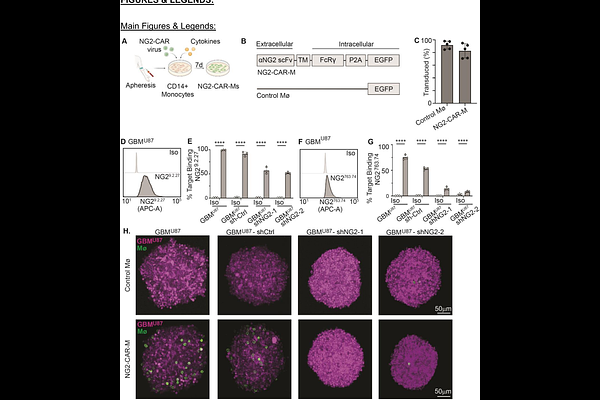
AbstractEngineering macrophages with chimeric antigen receptors is emerging as a promising cancer therapeutic. Chimeric antigen receptor-expressing macrophages (CAR-Ms) engineered to recognize tumor-specific antigens have been shown to inhibit tumor growth and activate adaptive immune responses, leading to robust tumor control in animal studies. Based on this work, clinical trials have been initiated. While the trials have shown promise, challenges remain. The dynamic interactions between CAR-Ms and cancer cells and the exact mechanisms driving anti-tumor effects remain poorly defined. Defining the dynamic interactions between CAR-Ms and cancer cells will provide critical insights for optimizing future CAR-M design and improving therapeutic efficacy. We sought to directly visualize CAR-M interactions with glioblastoma cells at high-resolution and in real-time using CAR-Ms engineered to recognize Neural-Glial Antigen 2 (NG2), an antigen expressed on glioblastoma cells. Using patient-derived glioblastoma cells, we formed glioblastoma spheroids and embedded them in a 3D matrix together with CAR-Ms. Using time-lapse microscopy, as expected, we found that NG2-targeting CAR-Ms engulfed glioblastoma cells. However, excitingly, we found that NG2-targeting CAR-Ms blocked >85% of glioblastoma cell invasion in 3D. This inhibition of glioblastoma invasion was not due to a significant change in CAR-M polarization states. Together, these data suggest that NG2-targeting CAR-Ms both engulf glioblastoma cells and block glioblastoma invasive behavior.