Cytosolic interaction with RNA-helicase DDX39A titrates viral RNA G-quadruplex mediated α-Synuclein amyloidogenesis

Cytosolic interaction with RNA-helicase DDX39A titrates viral RNA G-quadruplex mediated α-Synuclein amyloidogenesis
Jain, A.; Tripathi, S.; Agarwal, C.; Biswas, A.; Potharaju, P. S.; De, A.; Mansuri, S.; Mondal, A.; Harshan, K. H.; Raychaudhuri, S.
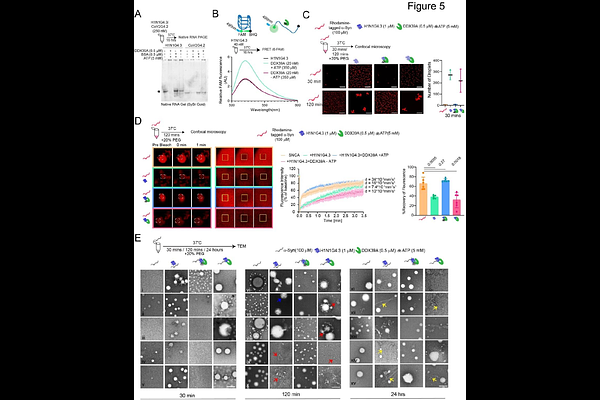
AbstractAmyloid aggregates of -Synuclein are hallmark of Parkinsons Disease (PD) and related neurodegenerative diseases. -Synuclein, being an non-canonical RNA-binding protein (RBP), associates with other RBPs within cytosolic RNA-protein granules to modulate mRNA-stability. Conversely, mRNA G-quadruplexes (rG4s) expedite -Synuclein amyloidogenesis. However, spatiotemporal control on -Synuclein amyloidogenesis by other RBPs remains unexplored. Here, we report that RNA-dependent cytosolic interaction with DEAD-box RNA-helicase DDX39A decelerates -Synuclein amyloidogenesis. Viral infections transiently elevate rG4s in cytoplasm. Perturbing interactions between -Synuclein and DDX39A using viral rG4s from H1N1-influenza and SARS-CoV-2 genomes expedites intracellular amyloidogenesis. Conversely, DDX39A overexpression alleviates -Synuclein amyloidogenesis in mouse primary neurons triggered by SARS-CoV-2 infection. We demonstrate that while DDX39A unwinds viral rG4s to mitigate -Synuclein sol-gel transition, its reciprocal cooperative phase separation with -Synuclein enhances the helicases rG4-unwinding activity. We propose that accelerated -Synuclein amyloidogenesis represents a trade-off within this RNA-protein interaction equilibrium, contributing to the viral etiology of PD.