Cross-talk among miRNAs, lncRNAs, and DNA methylation in three coral species reveal conserved epigenetic regulatory architecture

Cross-talk among miRNAs, lncRNAs, and DNA methylation in three coral species reveal conserved epigenetic regulatory architecture
Durkin, K. M.; Ashey, J.; Rodriguez-Casariego, J. A.; Dellaert, Z.; Bengtsson, Z.; White, S. J.; Eirin-Lopez, J. M.; Putnam, H. M.; Roberts, S. B.
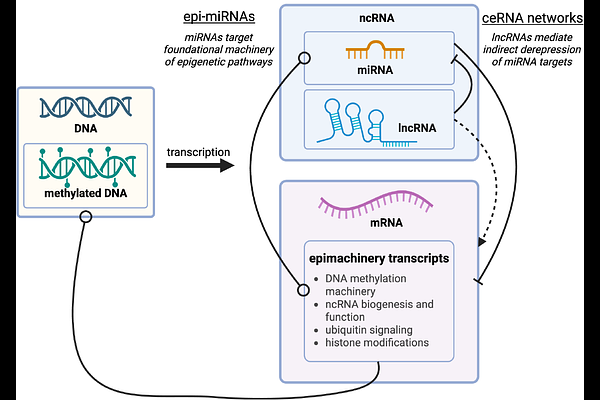
AbstractEpigenetic mechanisms support phenotypic plasticity across metazoans, enabling dynamic response to environmental change. DNA methylation and non-coding RNAs, including microRNAs (miRNAs) and long non-coding RNAs (lncRNAs), regulate gene expression through distinct but interconnected mechanisms. In vertebrate systems, these layers form integrated networks in which specific miRNAs directly target the protein machinery of other epigenetic processes ("epi-miRNAs") and specialized lncRNAs act as competing endogenous RNAs (ceRNAs), sequestering miRNAs from their mRNA targets. Whether equivalent cross-layer regulatory architectures exist in cnidarians, whose methylomes are invertebrate-characteristic and whose miRNAs function mechanistically like those of plants, is unknown. Here we integrate matched RNA-seq, small RNA-seq, and whole-genome bisulfite sequencing across three species of reef-building coral (Acropora pulchra, Porites evermanni, and Pocillopora tuahiniensis) to characterize the landscape and regulatory interactions of microRNAs (miRNAs), long non-coding RNAs (lncRNAs) and DNA methylation, including the first description of epi-miRNAs and ceRNA networks in cnidarian taxa. Across the study species, miRNAs putatively targeted transcripts encoding a suite of epigenetic processes, including DNA methylation regulators (TET3, MBD, PRDM14), ubiquitin-signaling and histone-modifying machinery, and components of the miRNA pathway itself (e.g., AGO, TNRC6). The conserved miRNA miR-100 also exhibited species-divergent target coexpression, suggesting lineage-specific regulatory roles for deeply conserved miRNAs. Candidate ceRNA networks were also recovered, including predicted derepression of epimachinery transcripts, indicating that lncRNA-mediated buffering operates alongside direct miRNA control. Recovery of these regulatory interactions across three evolutionarily divergent species, despite few orthologous miRNA or lncRNA, suggests that multi-layered epigenetic regulation is a conserved feature of cnidarian biology. These results establish direct miRNA and lncRNA control of epigenetic machinery as an active component of coral gene regulation, and provide foundational resources for studying how multilayered epigenetic interactions contribute to coral resilience to environmental change.