Carnitine deficiency alters fuel metabolism and voluntary wheel running in mice

Carnitine deficiency alters fuel metabolism and voluntary wheel running in mice
Kingren, M. S.; Sadler, D. G.; Bolin, E.; Harville, I.; Sikes, J.; Lan, R.; Borsheim, E.; Porter, C.
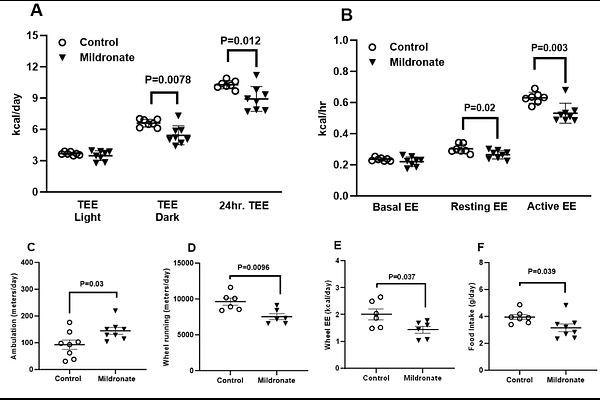
AbstractBackground: Carnitine plays an obligatory role in energetics owing to its role in the translocation of long-chain fatty acids into the mitochondrion for oxidation. Here, we determined the metabolic and behavioral consequences of systemic carnitine deficiency (SCD) in mice. Methods: Female C57BL/6J mice were randomized to receive normal drinking water (control, n = 8) or drinking water supplemented with mildronate 4g.L-1 (mildronate, n = 8) for 21 days. Body composition was assessed at baseline and post treatment. Metabolic and behavioral phenotyping was performed continuously over 72 hours following 14 days of control or mildronate treatment. Stable isotope were used to assess whole-body substrate oxidation. Carnitine subfractions were quantified in skeletal muscle and liver, as was mitochondrial respiratory function. Liver and muscle samples also underwent proteomic analysis. Results: Mildronate treatment depleted total carnitine in muscle and liver by ~97% (P < 0.001) and ~90% (P < 0.001), respectively. Carnitine depletion was accompanied by lower total energy expenditure (P = 0.01), attributable to lower voluntary wheel running (P = 0.01). Oxidation rates of palmitate (P < 0.01) but not octanoate were lower whereas rates of glucose oxidation were greater in carnitine depleted mice (P < 0.01). Mitochondrial respiratory capacity was unaltered by carnitine deficiency. Carnitine deficiency remodeled muscle and liver proteomes to support lipid oxidation and energy production. Summary: In mice, carnitine deficiency is characterized by decreased long-chain fatty acid oxidation despite preserved mitochondrial respiratory capacity. Carnitine deficiency resulted in lower voluntary exercise and a concomitant reduction in energy expenditure.