Mapping frog genomic diversity on a continental scale

Mapping frog genomic diversity on a continental scale
Barrow, L. N.; McDaniels, C. X.; Bishop, A. P.; Amador, L.; Wiley, D. L. F.; Eberle, C. M.; Mason, N. M.; Rosario Sanchez, E. O.; Giermakowski, J. T.; Hoffman, E. A.; Jongsma, G. F. M.; Michelsohn, M. J.; Nava Martinez, M.; Omlor, K. N.; Rivera, S. R.; Torres Lopez, A. S.; Warwick, A. R.; Webster, K. C.
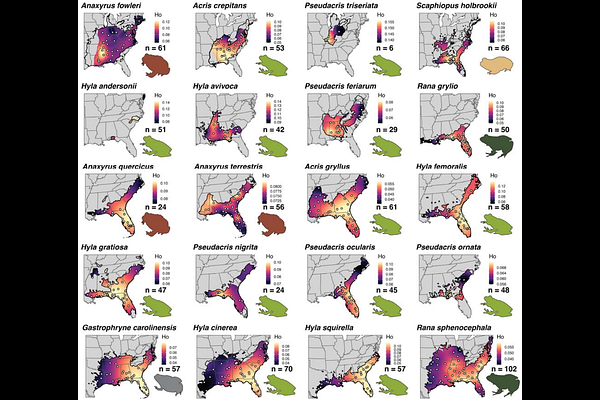
AbstractGenetic diversity is vital to adaptation and survival as environments change, yet we lack information about the spatial distribution of genetic variation for most wildlife populations. Here, we present new georeferenced, genome-wide data for 2,481 individuals from 46 frog species and leverage recent methods to visualize and analyze diversity within and across species. Our study identified several consistent spatial patterns of genomic diversity in eastern North American frogs. More than half (56.8%) of species exhibited a latitudinal gradient in genomic diversity, but we found little evidence for an association between genomic diversity and human disturbance. We further provide a general framework for mapping "hot spots" of high diversity and "cold spots" of low diversity to highlight priority areas for maintaining genomic diversity across multiple species.