Delayed predator response increases ecosystem's vulnerability to collapse under a changing environment

Delayed predator response increases ecosystem's vulnerability to collapse under a changing environment
Barreto Campos, A.; Prado, P. I.; Marquitti, F.
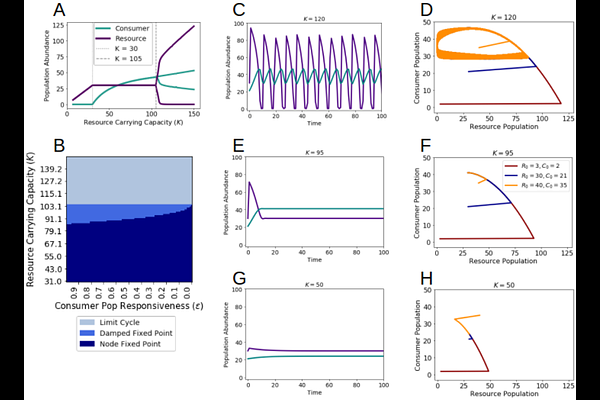
AbstractHuman activities are driving unprecedented environmental change, yet assessments of ecosystem resilience often overlook the rapid pace of change in the Anthropocene. Predator-prey systems are sensitive to the rate of environmental change and the whole system can collapse if predator population fail to promptly adjust to environmentally-driven shifts in resource population. Here, we investigate how different combinations of predator responsiveness and rates of environmental change influence the system vulnerability to critical transitions, explicitly addressing its interplay with magnitude of change. We found that, as predator responsiveness decreases, relatively slower rates and smaller magnitudes of environmental change leads to system collapse. Hence, even low and seemingly inoffensive total magnitudes of environmental change can be catastrophic if the rate of change is beyond a critical threshold. We propose considering predator responsiveness and current rates of environmental change as crucial factors in predicting the Anthropocene's impact on ecosystems.