Topological Data Analysis of Spatial Protein Expression in Multiplexed Spatial Proteomics Studies

Topological Data Analysis of Spatial Protein Expression in Multiplexed Spatial Proteomics Studies
Samorodnitsky, S. N.; Wu, M.
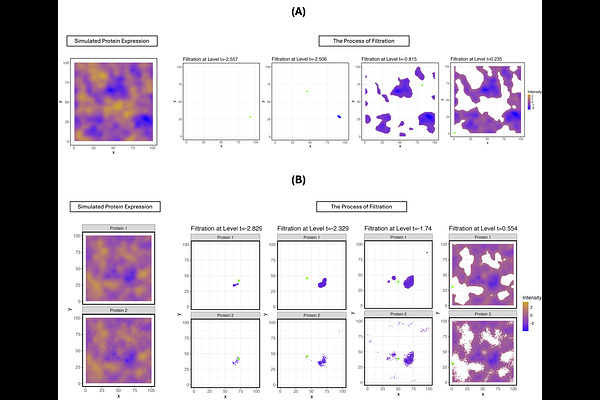
AbstractMultiplexed spatial proteomics platforms generate high-resolution images capturing the spatial expression of proteins in tissue. Images are often fed through a complex pre-processing pipeline to identify individual cells (termed segmentation) and then to predict their phenotypes. It is common to test if the inferred spatial arrangement of cells associates with patient-level outcomes. However, cell segmentation and phenotyping are prone to error and this approach neglects the measured protein levels. Further, new research suggests topological analysis of spatial proteomics may yield more power than alternative approaches. We propose a method, TOASTER, that circumvents reliance on segmentation and phenotyping and instead tests the association between continuous spatial protein expression and a patient-level response variable. TOASTER uses topological data analysis to first characterize the presence of topological features within univariate and bivariate spatial protein expression. The topological structure is summarized using an adaptation of the Nelson-Aalen cumulative hazard function. We can then associate this summary with an outcome using either a functional data analytic approach, a gridwise testing approach, or using kernel association testing. We show via simulation that our approach improves power and controls type I error, even in the presence of gaps or tears in the image which may arise during tissue handling. We apply our approach to a study in triple-negative breast cancer and demonstrate topological features of protein expression associated with immunotherapy response.