hNav1.5α forms an antiparallel intracellular homodimer but is incorporated into the plasma membrane as a monomer

hNav1.5α forms an antiparallel intracellular homodimer but is incorporated into the plasma membrane as a monomer
Schmalzing, G.; Li, L.
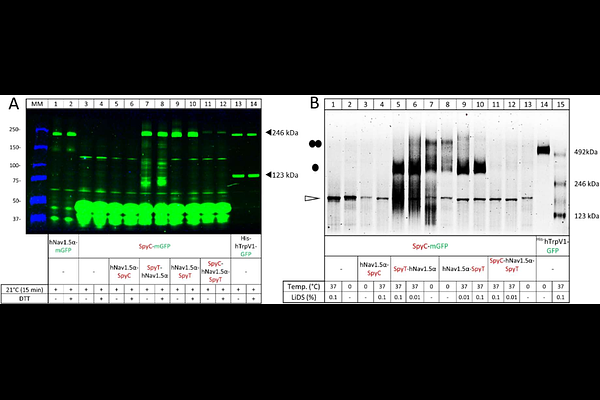
AbstractElectrophysiological studies have long treated the cardiac voltage-gated sodium channel Nav1.5a (SCN5A) as a monomeric pore-forming unit, consistent with all available cryo-EM structures, which show only monomeric architectures. In contrast, biochemical studies - cross-linking, single-molecule pulldown, and native electrophoresis - have reported 500 kDa Nav1.5a homodimers with coupled gating. To reconcile this apparent discrepancy, we combined selective labeling of the total (metabolic 35S-methionine) and plasma-membrane (membrane-impermeant IRDye 800CW) pools of hNav1.5a with high-resolution clear native electrophoresis (hrCNE) in Xenopus laevis oocytes. Total hNav1.5a migrated predominantly as a homodimer that dissociated into monomers upon denaturation, whereas surface-labeled hNav1.5a migrated exclusively as a monomer, confirming mature, Golgi-processed glycosylation by Endo H/PNGase F digestion. This monomer-dimer distribution was unaffected by co-expression with hNavbeta1-beta4 subunits. Using an orthogonal SpyCatcher/SpyTag covalent tagging strategy, we captured the intracellular homodimer as an irreversible 500 kDa complex, and engineered TEV protease cleavage sites revealed that the two protomers associate in a previously unrecognized antiparallel, cyclic arrangement. AlphaFold2-Multimer confidently predicted a monomeric hNav1.5a fold but failed to generate a high-confidence homodimer interface, indicating that this arrangement is not strongly sequence-encoded. Together, our data resolve the electrophysiology-biochemistry discrepancy: hNav1.5a assembles as an antiparallel homodimer in intracellular compartments, likely subject to quality control, but is delivered to the plasma membrane - the physiologically conducting compartment - exclusively as a monomer, irrespective of beta-subunit association.