Structural Mechanism of Electron Shuttling in Inducible Nitric Oxide Synthase

Structural Mechanism of Electron Shuttling in Inducible Nitric Oxide Synthase
Shi, Y.; Liu, X.; Chen, L.
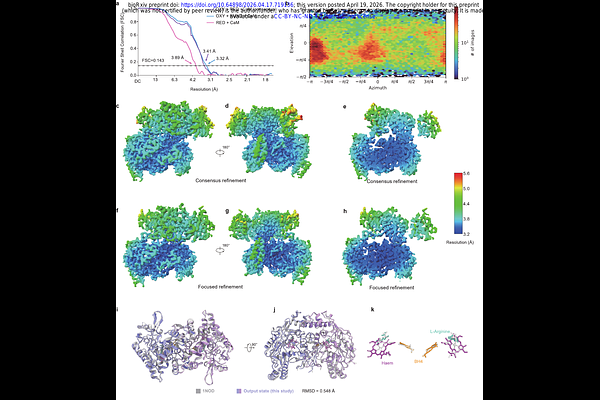
AbstractNitric oxide (NO) signaling is pivotal in numerous physiological processes and is implicated in a spectrum of human diseases. Nitric oxide synthases (NOS) initiate NO signaling and govern its magnitude and duration, making them key drug targets. Despite decades of investigation, the structural mechanism by which NOS enzymes transfer electrons from NADPH to haem remains incompletely understood. Here, we report cryo electron microscopy studies of the inducible NOS (iNOS) homodimer in complex with calmodulin captured under the catalytic turnover condition, resolving two important functional states: the electron input state and output state. In the input state, the FMN binding subdomain (FMND) docks onto the FAD/NADPH-binding subdomain (FNR), positioning the FMN cofactor to accept electrons from FAD. The FMND then undergoes a large rotational movement to engage the oxygenase domain of the other protomer, adopting the output state, which enables electron transfer from FMN to the haem center via W366. This dynamic movement of the FMND shuttles electrons from the reductase domain to the oxygenase active site in iNOS. A point mutation (S594E) that disrupts the FMND oxygenase interface markedly reduces catalytic activity of iNOS and traps the enzyme in a non-productive intermediate conformation. Together, these findings elucidate the structural mechanism of FMND mediated electron transfer in the iNOS catalytic cycle.