Using a GPT-5-driven autonomous lab to optimize the cost and titer of cell-free protein synthesis

Using a GPT-5-driven autonomous lab to optimize the cost and titer of cell-free protein synthesis
Smith, A. A.; Wong, E. L.; Donovan, R. C.; Chapman, B. A.; Harry, R.; Tirandazi, P.; Kanigowska, P.; Gendreau, E. A.; Dahl, R. H.; Jastrzebski, M.; Cortez, J. E.; Bremner, C. J.; Hemuda, J. C. M.; Dooner, J.; Graves, I.; Karandikar, R.; Lionetti, C.; Christopher, K.; Consiglio, A. L.; Tran, A.; McCusker, W.; Nguyen, D. X.; Nunes da Silva, I. B.; Bautista-Ayala, A. R.; McNerney, M. P.; Atkins, S.; McDuffie, M.; Serber, W.; Barber, B. P.; Thanongsinh, T.; Nesson, A.; Lama, B.; Nichols, B.; LaFrance, C.; Nyima, T.; Byrn, A.; Thornhill, R.; Cai, B.; Ayala-Valdez, L.; Wong, A.; Che, A. J.; Thavaraj
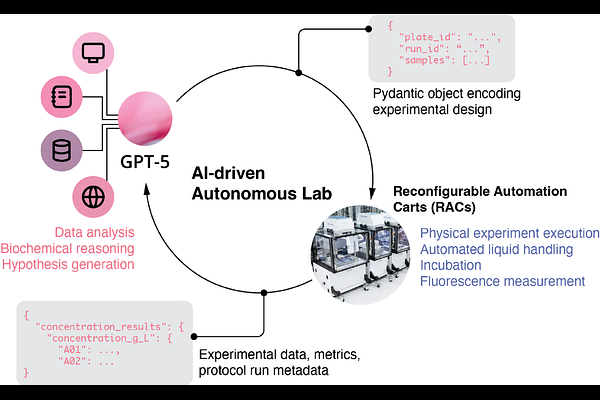
AbstractWe used an autonomous lab, comprising a large language model (LLM) and a fully automated cloud laboratory, to optimize the cost efficiency of cell-free protein synthesis (CFPS). By conducting iterative optimization, the LLM-driven autonomous lab was able to achieve a 40% reduction in the specific cost ($/g protein) of CFPS relative to the state of the art (SOTA). This cost reduction was accompanied by a 27% increase in protein production titer (g/L). Iterative experimental design, experiment execution, data capture and analysis, data interpretation, and new hypothesis generation were all handled by the LLM-driven autonomous lab. The interface between OpenAI's GPT-5 LLM and Ginkgo Bioworks' cloud laboratory incorporated built-in validation checks via a Pydantic schema to ensure that AI-designed experiments were properly specified. Experimental designs were translated into programmatic specification of multi-instrument biological workflows by Ginkgo's Catalyst software and executed on Ginkgo's Reconfigurable Automation Cart (RAC) laboratory automation platform, with human intervention largely limited to reagent and consumables preparation, loading and unloading. By integrating LLMs with programmatic control of a cloud lab, we demonstrate that an LLM-driven autonomous lab can successfully perform a real-world scientific task, highlighting the potential of AI-driven autonomous labs for scientific advancement.