Differentiable Design for Morphogenesis I: Simulation and Simulacra

Differentiable Design for Morphogenesis I: Simulation and Simulacra
Beker, O.; Dumitrascu, B.
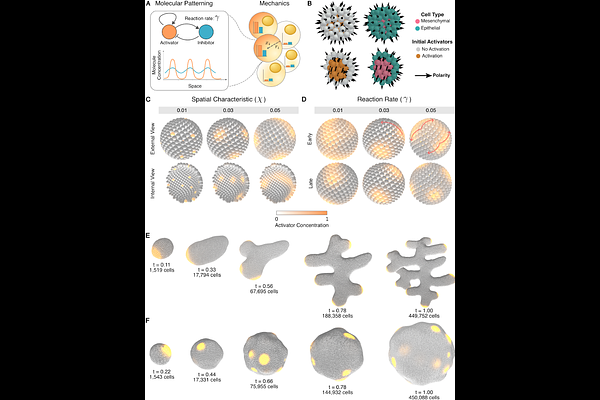
AbstractCells build tissues through local exchanges of force and information, yet the rules governing these interactions are difficult to infer from sparse observations. Here, we introduce waxMorph, a differentiable cell-based framework for generating and reconstructing three-dimensional morphogenesis. In synthetic and biological data, waxMorph reproduced established mechanochemical shape programs, inferred continuous trajectories from static tissue volumes, and recovered spatially organized latent signals. In a developing mouse myocardium dataset, it reconstructed unobserved intermediate geometries more accurately than optimal-transport interpolation, while in forelimbs it distinguished related developmental trajectories. By varying the capacity and spatial organization of the latent cues available to cells, waxMorph also provides a model-based way to quantify the complexity of shape assembly. waxMorph is built within the spatial-computing ecosystem of NVIDIA Warp. It provides an open-source, Python-native, GPU-accelerated, hybrid physics-AI framework for learning how local cellular interactions give rise to biological form.