Combination of alpha-synuclein aggregation inhibitor anle138b and ER stress inhibitor AMG PERK 44 increases neuroprotection in Parkinson's disease organoid model

Combination of alpha-synuclein aggregation inhibitor anle138b and ER stress inhibitor AMG PERK 44 increases neuroprotection in Parkinson's disease organoid model
Siwecka, N.; Golberg, M.; Galita, G.; Majsterek, I.
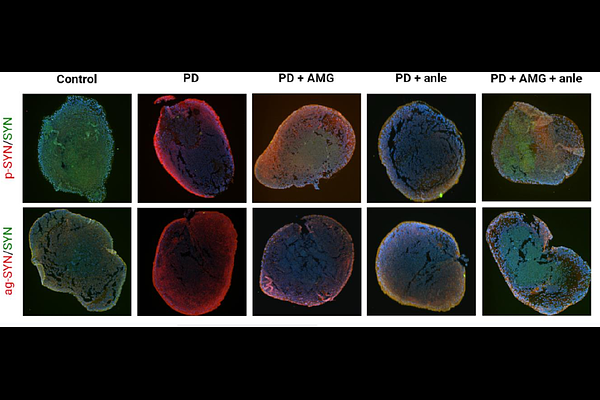
AbstractParkinson's disease (PD) is the second most common neurodegenerative disease, resulting from accumulation of -synuclein (-syn) in midbrain dopaminergic neurons and progressive neuronal loss. The most relevant species of -syn, oligomers, may exert neurotoxicity in a variety of mechanisms. Accumulation of misfolded -syn in the endoplasmic reticulum (ER) lumen induces ER stress conditions that leads to activation of the Unfolded Protein Response (UPR) and its main sensor PKR-like ER kinase (PERK). PERK is critical for cell fate determination - under prolonged ER stress, it may direct cell towards pro-apoptotic pathways. Targeting of -syn aggregation or UPR by genetic and pharmacological approaches proved effective in preclinical models of PD by previous research. Thus, in the present study, we aimed to determine the potential effect of combination of small-molecule inhibitors of -syn aggregation and ER stress-mediated PERK signaling (namely anle138b and AMG44) in a novel, 3D in vitro model of PD. We demonstrate that combination of both anti-aggregation and ER stress-targeting approaches amplifies neuroprotection against PD in organoid model in terms of increased neuronal metabolic activity, decreased -syn phosphorylation and aggregation, reduced dopaminergic cell death, and restoration of proteostasis.