Exploring the impact of microbial manipulation on the early development of kelp (Saccharina latissima) using an ecological core microbiome framework.

Exploring the impact of microbial manipulation on the early development of kelp (Saccharina latissima) using an ecological core microbiome framework.
Park, J.; Schenk, S.; Davis, K.; Clark, J.; Wegener Parfrey, L.
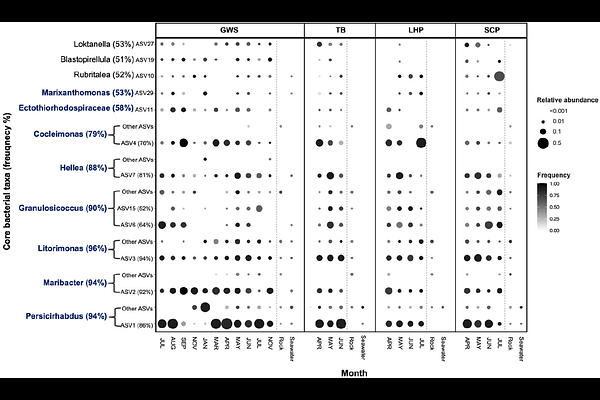
AbstractKelp cultivation is a rapidly expanding economic sector, as kelp are valued for a wide range of commercial products and for restoration of kelp forest ecosystems. Microbes associated with kelp and other macroalgae play a critical role in processes such as nutrient exchange, chemical signaling, and defense against pathogens. Thus, manipulating the microbiome to enhance macroalgal growth and resilience is a promising, but largely untested, tool in sustainable kelp cultivation. The core microbiome hypothesis suggests that bacteria that are consistently found on a host (the core microbes) are likely to have a disproportionate impact on host biology, making them an attractive target for microbiome manipulation. Here, we surveyed wild Saccharina latissima and their surrounding environment to identify core bacterial taxa, compared to cultivated kelp, and experimentally tested the effect of cultured bacterial isolates on kelp development. We find that core bacteria are nearly absent in cultivated juvenile sporophytes in nurseries but eventually colonized after outplanting kelp to ocean farm sites. We find that bacterial inoculants can have both positive and negative effects on kelp development. In line with predictions from the core microbiome hypothesis, we find a positive correlation between the frequency of the bacterial genus in the wild and the bacterial effect on the number of sporophytes in kelp co-culture experiments.