Phylotranscriptomics reveals convergent behavioral evolution associated with shared and unique mechanisms in cavity-nesting songbirds

Phylotranscriptomics reveals convergent behavioral evolution associated with shared and unique mechanisms in cavity-nesting songbirds
Lipshutz, S. E.; Hibbins, M. S.; Bentz, A. B.; Buechlin, A. M.; Empson, T. A.; George, E. M.; Hauber, M. E.; Rusch, D. B.; Schelsky, W. M.; Thomas, Q. K.; Torneo, S. J.; Turner, A. M.; Wolf, S. E.; Woodruff, M. J.; Hahn, M. W.; Rosvall, K. A.
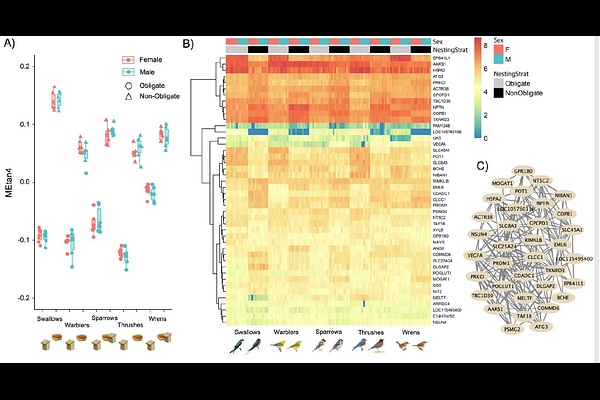
AbstractUncovering the genomic bases of phenotypic adaptation is a major goal in biology, but this has been hard to achieve for complex behavioral traits. Here, we leverage the repeated, independent evolution of obligate cavity-nesting in birds to test the hypothesis that the shared pressure to compete for a limited breeding resource drives convergent behavioral evolution via convergent gene regulatory changes in the brain. Using behavioral assays in the field, hormonal measures of free-living subjects, and transcriptome-wide analyses of the brain in wild-captured males and females, we examined five species pairs across five avian families, each including one obligate cavity-nesting species and a related species with an open cup-nesting or otherwise more flexible nest strategy. Results support the hypothesis of behavioral convergence, with higher levels of territorial aggression in obligate cavity-nesters, particularly among females. Levels of testosterone in circulation were not associated with nest strategy or aggression for either sex, but phylogenetic analyses of individual genes and co-regulated gene networks revealed some shared patterns of gene expression, including a nest strategy-related gene network shared across families and two separate networks linked to aggression only in females. Though associated with convergent behavioral evolution, these genes were not significantly enriched for particular functional pathways, and the scope of convergent gene expression evolution was limited to a small percent of the genome. Together, these observations indicate that replicated evolutionary changes in complex behavior arise via a combination of convergent and lineage-specific evolution of gene regulation.