FOXA1 preserves cell polarity and restrains lysosome biogenesis in non-small cell lung adenocarcinoma

FOXA1 preserves cell polarity and restrains lysosome biogenesis in non-small cell lung adenocarcinoma
Wang, X.; Zhang, B.; Sun, C.; Huang, M.; Huang, W.; Zhang, B.; Zhang, X.; Ren, X.; Luo, L.; Liang, H.; Zhou, Y.; Zhong, G.; Lin, S.; Tortorella, M. D.; Tan, T. Z.; Liang, W.; Thiery, J. P.; He, J.
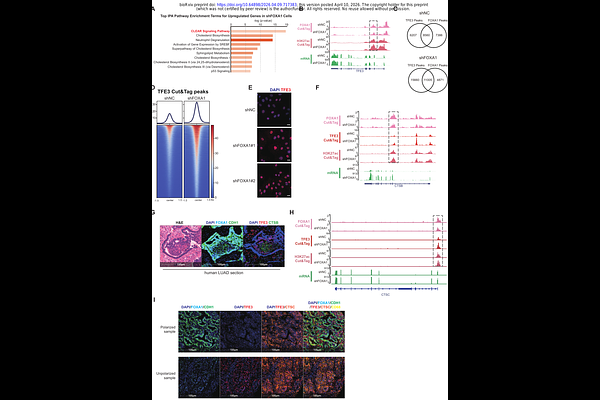
AbstractBackground: This study investigates the role of the pioneer transcription factor FOXA1 as a master gene in sustaining epithelial cell polarization in early stage lung adenocarcinoma. The partial loss of FOXA1 is explored to determine if it will affect plasticity and progression of lung adenocarcinoma. The study also addresses the transcriptional circuitry that links polarity defects to lysosome homeostasis. Methods: A multiomics approach was used to define the status of the chromatin in epithelial and mesenchymal states of A549 adenocarcinoma cells obtained with a newly synthetized TGF-beta; receptor inhibitor or TGF-beta; respectively. The study leveraged ATAC-seq, RNA sequencing, Cut&Tag sequencing of FOXA1 and histone marks profiling. The functional impact of FOXA1 was examined by partial silencing in vitro and by heterozygous FOXA1 deletion in a KrasG12D mouse model. Three-dimensional organoid culture, high-resolution electron microscopy, spatial transcriptomics and multiplex immunohistochemistry assessed carcinoma cell polarity, proliferation, the tumor microenvironment and organelle content. Group differences were evaluated with two-tailed t tests or one-way analysis of variance. Results: FOXA1 binding and expression were highest in cells harboring an epithelial phenotype. In mouse KrasG12D LUAD tumors FOXA1 marked polarized, CDH1-positive cells; heterozygous loss diminished CDH1, disrupted apical-basal architecture, lowered organoid-forming efficiency and remodeled the immune microenvironment. Spatial transcriptomics and ultrastructural analyses showed that FOXA1-deficient carcinoma cells accumulated lysosomes, down-regulated vesicle fusion genes of the SNARE family and activated the lysosomal CLEAR gene network. FOXA1 occupied enhancers of lysosome-associated genes and competed with the transcription factor TFE3, thereby suppressing transcription of cathepsin B and cathepsin C and restricting lysosome biogenesis. Conclusions: FOXA1 is a central regulator that preserves epithelial cell polarity and limits lysosome formation in lung adenocarcinoma. Targeting the FOXA1-TFE3-lysosome axis may affect tumor plasticity and provide new therapeutic opportunities.