Pathway selection for arabinose utilization in Pseudomonas putida reveals a rate-yield tradeoff in muconic acid production from lignocellulosic sugars

Pathway selection for arabinose utilization in Pseudomonas putida reveals a rate-yield tradeoff in muconic acid production from lignocellulosic sugars
Kim, D.; Lind, T. M.; Ling, C.; Klein, B. C.; Merrill, A. N.; Van Roijen, E.; Benavides, P. T.; Benson, A. F.; Elmore, J. R.; Ingraham, M. A.; Kuatsjah, E.; Meyer, N. R.; Mokwatlo, S. C.; Ramirez, K. J.; Guss, A. M.; Bleem, A. C.; Salvachua, D.; Johnson, C. W.; Beckham, G. T.
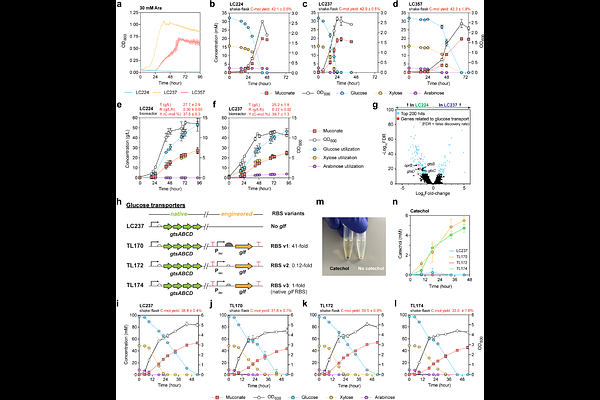
AbstractEngineering heterologous utilization of substrates requires selection of catabolic pathways that balance strain performance and product biosynthesis. Here, we compare the oxidative and isomerase arabinose utilization pathways in Pseudomonas putida strains engineered for cis,cis-muconic acid production from glucose and xylose. Based on the point of entry into central carbon metabolism, we hypothesized that the oxidative arabinose pathway would enable higher productivity while the arabinose isomerase pathway would enable higher muconate yield. In both strains, additional modifications were engineered to improve muconic acid production including sugar transporter tuning, catechol 1,2-dioxygenase overexpression, a feedback-resistant DAHP synthase, and a flux-stabilizing gltA variant. Consistent with our hypothesis, the oxidative arabinose pathway supported faster growth and higher productivity (0.58 g/L/h), whereas the arabinose isomerase pathway improved carbon efficiency, achieving muconate yields of up to 50 C-mol% in fed-batch bioreactors. Process modeling indicates that these performance metrics can reduce the minimum selling price of muconate-derived adipic acid to $2.74/kg and greenhouse gas emissions to 1.31 kg CO2e/kg, approaching cost parity and reducing emissions by 86% relative to fossil carbon-derived adipic acid. Overall, this study presents a systematic comparison of sugar catabolic pathways that enabled development of strains suited for the tradeoffs between rate and yield.