Lipid-conjugated DNA enables on-demand delivery of lipids and proteins to synthetic cells

Lipid-conjugated DNA enables on-demand delivery of lipids and proteins to synthetic cells
Van Herck, B.; Kerssemakers, J.; Risgaard, N. A.; Vogel, S.; Dekker, C.; Koenderink, G. H.
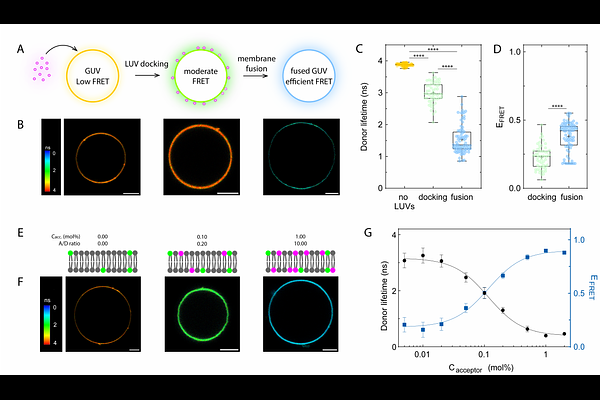
AbstractThe bottom-up construction of synthetic cells based on giant unilamellar vesicles (GUVs) is a central goal in synthetic biology. Achieving targeted changes in membrane and cytoplasmic composition with temporal control remains challenging however. DNA-mediated fusion with small vesicles (~100 nm large unilamellar vesicles; LUVs) has been proposed as a strategy to deliver lipids and cytosolic contents in a programmable manner. However, in vitro, membrane fusion is generally found to be inefficient and poorly controllable for reasons that are poorly understood. Here, we present an approach based on lipid-conjugated DNA (LiNA) to mediate programmable fusion between LUVs and micron-sized GUVs, which we quantitatively monitor with confocal microscopy at the single-GUV level. We show that lipid and content mixing both occur with high efficiency over a wide range of LiNA concentrations, demonstrating that LiNAs indeed induce robust membrane fusion. Furthermore, we show that LiNA-mediated fusion provides a powerful tool to deliver cytosolic biomolecules, enabling control over internal activities. Our findings establish a quantitative framework for studying fusion-driven processes in synthetic cells and provide a versatile platform for the programmable delivery of lipids and cytosolic cargoes - thus advancing the development of synthetic cells that can grow and adapt through fusion-based uptake of molecular building blocks.