Equivalent fitness increase achieved by active learning-navigated habitat reconstruction and evolution-induced genome mutation

Equivalent fitness increase achieved by active learning-navigated habitat reconstruction and evolution-induced genome mutation
Lu, Z.; Ying, B.-W.
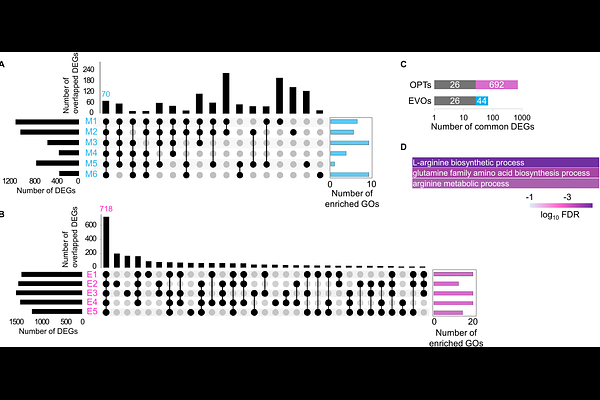
AbstractFitness increase, impacted by genetic and environmental traits, requires evolutionary changes in genomes or ecological changes in habitats. Whether and how habitat reconstruction can compensate for the genetic changes remains unclear. The present study offers an experimental comparison of bacterial fitness increase via evolutionary and ecological strategies to verify that habitat reconstruction has the potential to avert genetic restriction, challenging the genetic-only view of adaptation. Six finely tuned media with different combinations and five evolved lineages with different mutations, both of which allowed equivalent increases in bacterial growth rates, were achieved through active machine learning and experimental evolution, respectively. Transcriptome changes accompanied by fitness increase were limited but divergent among the six fitted media, compared to changes that were broad but similar among the five fitted genomes. The universal transcriptome reorganization in fitted genomes and media was likely driven by surrounding metabolisms, indicating escape routes for genetic changes that increase fitness through habitat reconstruction.