Engineered Pseudomonas putida reconfigures metabolic fluxes to support energy demands during muconate bioproduction from lignin-related aromatics

Engineered Pseudomonas putida reconfigures metabolic fluxes to support energy demands during muconate bioproduction from lignin-related aromatics
Wilkes, R. A.; Suthers, P. F.; Borchert, A. J.; Callaghan, M. M.; Thusoo, E.; Giannone, R. J.; Carper, D. L.; Hendry, J. I.; Benson, A. F.; Gapuz, M. A.; Merrill, A. N.; Ramirez, K. J.; Salvachua, D.; Hettich, R. L.; Maranas, C. D.; Amador-Noguez, D.; Beckham, G. T.; Werner, A. Z.
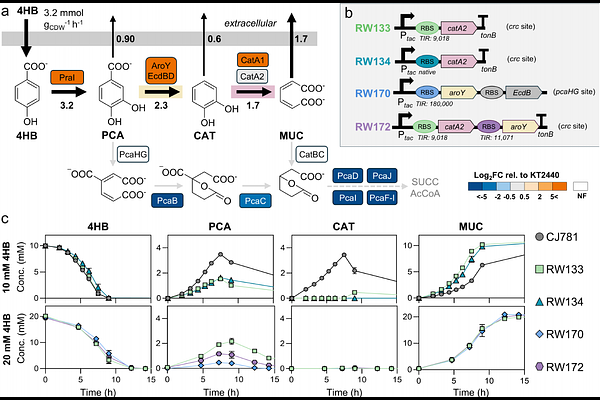
AbstractMuconic acid is a versatile platform chemical that can be biologically produced from lignocellulosic substrates, including from lignin-related aromatic compounds. Pseudomonas putida has been previously engineered to convert lignin-related aromatic compounds to muconate at quantitative molar yields. This high atom efficiency requires a supplemental carbon and energy source to support bacterial growth, and central carbon metabolic efficiency and its interaction with aromatic catabolism are underexplored. Here, we applied proteomics, metabolomics, and 13C-fluxomics to quantitatively compare central carbon and energy metabolism in wild-type P. putida KT2440 and a muconate-producing strain, P. putida CJ781. During cultivation on glucose and 4-hydroxybenzoate, CJ781 showed increased glucose uptake, reconfigured central fluxes, and increased extracellular leakage of aliphatic acids relative to wild type. These altered fluxes supported a 3-fold higher ATP pool, in excess of demand. Pyruvate and acetate secretion in CJ781 was mitigated by debottlenecking TCA-cycle entry via citrate synthase overexpression. Furthermore, tuned expression of the catechol dioxygenase and protocatechuate decarboxylase enabled the production of 36.3 g L-1 muconate at 1.1 g L-1 h-1. Overall, this work reveals how P. putida redirects carbon and energy fluxes to support aromatic bioconversion for improved bioproduction from renewable feedstocks.