Floquet ground state order
0upvotes
By: Suman Mondal, Paul M. Schindler, Marin Bukov
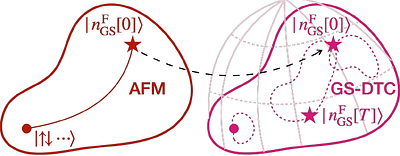
Clean, interacting, periodically driven systems are believed to thermalize to featureless, infinite-temperature states that preclude the formation of stable ordered states. Here, we show stable quantum order, distinct from prethermal order, and its phase transitions in the ground state of the average-energy operator. Decomposing the time evolution into geometric and average-energy dynamics, we apply Geometric Floquet theory to identify the Fl... more
Clean, interacting, periodically driven systems are believed to thermalize to featureless, infinite-temperature states that preclude the formation of stable ordered states. Here, we show stable quantum order, distinct from prethermal order, and its phase transitions in the ground state of the average-energy operator. Decomposing the time evolution into geometric and average-energy dynamics, we apply Geometric Floquet theory to identify the Floquet ground state. We derive a general variational principle to compute the Floquet ground state in large interacting periodically driven systems, and use it to develop a matrix product state algorithm. In driven nonintegrable chains of more than 100 interacting spins, our numerical simulations exhibit a gapped, area-law entangled Floquet ground state in extended parameter regimes; the ground-state manifold can support both dressed equilibrium order (e.g., Floquet antiferromagnets) and inherently nonequilibrium order (e.g., ground-state time crystals). This quantum order is protected by a finite average-energy gap, which closes at phase transition points upon changing model parameters. We decompose Floquet phases of matter into their equilibrium and nonequilibrium elements: whereas the Floquet ground state at any fixed time is a representative of an equilibrium phase of matter, the nonequilibrium content is entirely produced by the drive holonomy and is geometric. Finally, we identify quasilocal counterdiabatic driving as a mechanism for the stability against heating of gapped Floquet ground states in nonintegrable quantum systems, and argue why Floquet ground states evade the Eigenstate Thermalization Hypothesis. Our work enables the study of interacting nonequilibrium matter deep into the many-body regime, and lays the foundations for the engineering of strongly correlated ordered quantum states. less

By: Adam Siegel
Quantum low-density parity-check codes now reach encoding rates up to 50% at useful distances. Their checks however are long-range group actions, not local neighbourhoods, and that connectivity has so far been supplied by neutral atoms. Silicon spin qubits offer the same primitive --- coherent transport of qubit blocks --- through electron shuttling, and on microsecond rather than millisecond timescales. They however travel along fabricated t... more
Quantum low-density parity-check codes now reach encoding rates up to 50% at useful distances. Their checks however are long-range group actions, not local neighbourhoods, and that connectivity has so far been supplied by neutral atoms. Silicon spin qubits offer the same primitive --- coherent transport of qubit blocks --- through electron shuttling, and on microsecond rather than millisecond timescales. They however travel along fabricated tracks rather than free space: permutations an atom array obtains by moving tweezers must here become collision-free motions on a physical lattice. We here present the first code and spin-qubit hardware co-design. We build an architecture whose geometry mimics that of a family of non-abelian groups, broad enough to host codes of excellent parameters: a hierarchy of nested conveyor-belt loops on a plain square lattice of shuttling tracks, in which every group multiplication becomes a rigid, globally controlled motion of whole qubit trains. We call it NeST, for Nested Shuttling Tracks. A code search over the family returns rate-20% mitten codes up to $[[1400,280,\leq 28]]$, and circuit-level simulations including shuttling dephasing give thresholds above $10^{-3}$ with sub-$50μ$s stabiliser cycles, two to three orders of magnitude faster than neutral-atom implementations. Via extrapolations, we estimate that this largest code may reach a logical error probability per qubit per round of $10^{-14}$, assuming a ten-fold improvement on early shuttling demonstrations, with other physical errors at p=0.1%. Logic is compatible with NeST too: for the [[150,30,10]] code we build a code-surgery gadget in which every qubit again moves only by rigid belt motions, at no qubit cost and a 29% increase in gate layers. This demonstrates that ultra-low-overhead fault tolerance and a fast clock speed are not competing goals, and that silicon spin qubits can supply both. less
By: Thiago Assumpção, Ignacio Brevis, Irene Pitsiladi, Martin Zinzen, Miguel Bezares
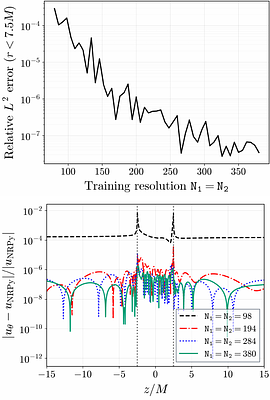
We present Pinndorama, a physics-informed neural network (PINN) code for solving the Hamiltonian constraint in the puncture formalism. The networks are trained solely on the governing equation and boundary conditions, without an analytical or perturbative guiding solution, with collocation points sampled in curvilinear coordinates. Training combines two optimization algorithms: an initial stage using adaptive moment estimation (Adam), followe... more
We present Pinndorama, a physics-informed neural network (PINN) code for solving the Hamiltonian constraint in the puncture formalism. The networks are trained solely on the governing equation and boundary conditions, without an analytical or perturbative guiding solution, with collocation points sampled in curvilinear coordinates. Training combines two optimization algorithms: an initial stage using adaptive moment estimation (Adam), followed by the self-scaled Broyden quasi-Newton method. We apply this approach to a spherically symmetric test problem with a known exact solution, axisymmetric binary punctures with unequal spins, and a fully three-dimensional GW150914-like configuration with unequal spins and orbital momenta. Comparisons with the NRPyElliptic solver yield relative $L^2$ errors of order $10^{-8}$ in axisymmetry and $10^{-5}$ in three dimensions. In addition, we reduce the hyperbolic-relaxation time in NRPyElliptic by a factor of approximately $4.6$ by training a parametric network that takes the puncture spin as input and provides a physics-informed initial guess to the solver. These results demonstrate that PINNs can provide accurate binary-puncture initial data and complement conventional elliptic solvers in numerical relativity. less
By: Tousif Islam
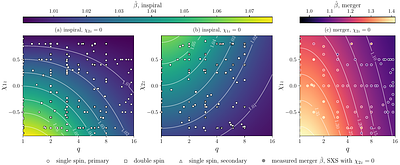
Black-hole perturbation theory remains remarkably accurate beyond its formal small-mass-ratio regime, but what limits this accuracy remains unclear. We develop a modular time-domain Teukolsky framework that isolates finite-mass-ratio corrections to the orbital dynamics while keeping the radiation at first perturbative order. Comparisons with numerical relativity show that the dominant source of discrepancy changes across the waveform. For non... more
Black-hole perturbation theory remains remarkably accurate beyond its formal small-mass-ratio regime, but what limits this accuracy remains unclear. We develop a modular time-domain Teukolsky framework that isolates finite-mass-ratio corrections to the orbital dynamics while keeping the radiation at first perturbative order. Comparisons with numerical relativity show that the dominant source of discrepancy changes across the waveform. For nonspinning binaries, the available second-order dissipative flux removes $87\%$ of the inspiral rate discrepancy, bringing it to within $\sim1\%$ of numerical relativity. For precessing binaries, we identify a $ν^2\sin^2ι$ dependence in the inspiral time rescaling that is not explained by the leading orbit-averaged post-Newtonian terms, suggesting finite-mass-ratio corrections to precessional dynamics. Near merger, the same dissipative correction removes only $1$--$2\%$ of the discrepancy. We show instead that the merger offset is quantitatively accounted for by the difference between the initial Kerr background used in the perturbative evolution and the remnant black hole, with $96\%$ of the leading predicted frequency shift arising from the change in spin rather than mass. We release $1571$ time-domain waveforms for $348$ binaries as the Vishveshwara Catalog. less

By: Junbin Li
We give a new rigorous construction of outer trapped surface formation in smooth vacuum spacetimes without symmetry assumptions. The outer trapped surface is produced by the collision of two transversely localized, nearly plane-fronted gravitational waves described by short pulse data. The outer trapped surface is obtained by joining two smooth pieces along a curve with their future-directed outer null normals matching continuously. The incom... more
We give a new rigorous construction of outer trapped surface formation in smooth vacuum spacetimes without symmetry assumptions. The outer trapped surface is produced by the collision of two transversely localized, nearly plane-fronted gravitational waves described by short pulse data. The outer trapped surface is obtained by joining two smooth pieces along a curve with their future-directed outer null normals matching continuously. The incompleteness of the maximal future development is then established by adapting Penrose's original argument. This construction is inspired by Penrose's argument in constructing a marginally outer trapped surface in the collision of two ultra-relativistic particles modeled by the Aichelburg--Sexl solution. less
By: Stefano Veroni, Aydin Deger, Andrew J. Daley
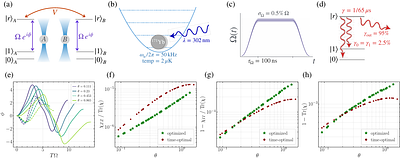
Fault-tolerant (FT) quantum computation offers a pathway to quantum advantage, but its realization is hindered by its significant overhead. The partially FT "STAR" architecture reduces the cost of universal computation at the price of relaxing FT requirements for non-Clifford operations, increasing exposure to hardware noise. Therefore, maximizing its performance and applicability demands careful co-design with the underlying hardware. In thi... more
Fault-tolerant (FT) quantum computation offers a pathway to quantum advantage, but its realization is hindered by its significant overhead. The partially FT "STAR" architecture reduces the cost of universal computation at the price of relaxing FT requirements for non-Clifford operations, increasing exposure to hardware noise. Therefore, maximizing its performance and applicability demands careful co-design with the underlying hardware. In this work we investigate the co-design of the STAR architecture with neutral-atom platforms, connecting the underlying atomic physics to logical error modeling and application-level performance. At the physical level, we identify a favorable noise bias in $^{171}\mathrm{Yb}$ Rydberg gates, and show how it can be enhanced through error-selective pulse optimization. At the logical level, we identify an intrinsic error suppression mechanism, yielding vanishing logical coherent noise in leading order. Detailed circuit-level simulations of surface code implementations show more than an order of magnitude reduction in logical error relative to previous estimates. As a concrete target application, we focus on the Fermi-Hubbard model with periodic boundaries, for which we design a simulation circuit particularly suited to early implementations. We quantify the resource tradeoff of partially and fully FT approaches to gate synthesis, with the former showing approximately an order of magnitude reduction in state-injection depth, and an even larger reduction in Clifford resources. Comparing with classical and fully FT approaches, we identify regimes where partial fault tolerance provides both lower overheads and lower error rates. In our estimates, this is accessible with moderate error rates $p\sim 10^{-3}$ and a few thousand qubits, underlining that for these types of problems, partial FT approaches provide a compelling pathway to early quantum advantage. less
By: Zuo Wang, Paul M. Schindler, Modesto Orozco-Ruiz, Nguyen H. Le, Florian Mintert, Marin Bukov
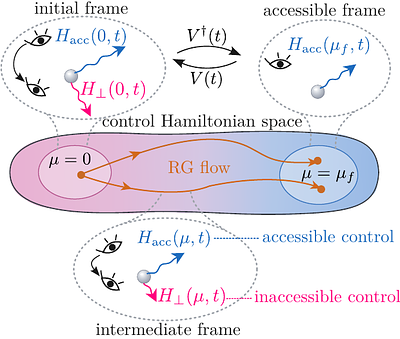
The Renormalization Group (RG) establishes relations between effective descriptions of physical systems at different scales; in Hamiltonian RG, these relations induce a flow in the space of Hamiltonians. In direct correspondence, we design an RG framework for quantum control by constructing a flow in the space of time-dependent Hamiltonians. A prescribed control subspace, selected to contain only experimentally accessible terms, forms the fix... more
The Renormalization Group (RG) establishes relations between effective descriptions of physical systems at different scales; in Hamiltonian RG, these relations induce a flow in the space of Hamiltonians. In direct correspondence, we design an RG framework for quantum control by constructing a flow in the space of time-dependent Hamiltonians. A prescribed control subspace, selected to contain only experimentally accessible terms, forms the fixed-point manifold, while the flow preserves the target unitary and monotonically reduces the Hamiltonian weight outside this subspace. Exploiting the freedom in constructing the flow, we introduce flow-equation engineering to enhance the versatility of the framework for diverse control problems, including time-periodic and open-interval smooth protocols with prescribed endpoints. We provide two disparate applications to exhibit the utility of our approach: (i) Nonperturbative Floquet engineering beyond the regime of validity of high-frequency expansions, which we demonstrate by constructing an implementable time-periodic protocol for the Haldane model; (ii) Accessible fast-forward driving from unit-fidelity counterdiabatic evolution, which we showcase for large transverse-field Ising chains away from the adiabatic regime by compressing the long-range multibody adiabatic gauge potential into the original time-dependent Ising control schedules. Our control RG framework reveals a unifying perspective on Hamiltonian engineering and unitary quantum control, and can serve as an organizing principle behind seemingly disparate nonequilibrium quantum dynamics. less

By: A. G. Kim, P. E. Nugent, L. Wang
Quantum-gravitational spacetime foam varying in space and in time imprints, respectively, a transverse phase decoherence and an achromatic, stochastic arrival-time jitter on light from distant sources. We show that the jitter modifies the first-order temporal coherence $g^{(1)}(τ)$ and hence the observed spectrum, providing a spectroscopic probe of the temporal variation, complementary to existing imaging-channel constraints on the spatial va... more
Quantum-gravitational spacetime foam varying in space and in time imprints, respectively, a transverse phase decoherence and an achromatic, stochastic arrival-time jitter on light from distant sources. We show that the jitter modifies the first-order temporal coherence $g^{(1)}(τ)$ and hence the observed spectrum, providing a spectroscopic probe of the temporal variation, complementary to existing imaging-channel constraints on the spatial variation. In the dynamical-foam limit, where the foam decorrelates within the light's coherence time, the spectrum splits into a coherent line core suppressed by $e^{-σ_φ^2}$, with $σ_φ^2$ the variance of the foam-induced phase jitter, and an incoherent pedestal, yielding a spectral shape-distortion bound on the foam exponent $α$. Three probes follow: the outright survival of broadband flux, the fractional width of a spectral line, and a chromatic deficit across a broadband continuum. Applied to the MeV emission lines of GRB\,221009A we obtain $α\gtrsim 0.63$, a weak, lever-arm-dominated floor. For the broadband CMB the foam induces an $e^{-σ_φ^2(ν)}$ deficit ($σ_φ^2 \propto ν^2$); a fit to the COBE/FIRAS monopole spectrum reaches $α\gtrsim 0.52$ ($95\%$ CL), and next-generation spectrometers reach only $α\gtrsim 0.54$--$0.55$ (forecast), limited by the foam--temperature degeneracy. The pedestal-independent line-width and CMB bounds are floors below the holographic value $α= 2/3$, consistent with and excluding no part of the imaging window reported for GRB\,221009A; only the conditional TeV survival bound ($α\gtrsim0.74$), which holds only for near-Planck-refresh foam ($τ_{\rm foam}\lesssim4\times10^{-28}$\,s), would exclude it --- and, with it, the window. less

By: Zihao Lin, Jef Heynen, Mick Wright, Thomas C. K. Ng, Chris Van Den Broeck, Justin Janquart
As the rate of gravitational wave detections continues to grow, the probability of observing a gravitationally lensed gravitational wave also increases. When the Schwarzschild radius of the lens is comparable in size to the gravitational wave wavelength, wave-optics effects induce a frequency- dependent modulation on the signal. CPU-based parameter estimation analyses for wave-optics lensing are computationally intensive, limiting the scale o... more
As the rate of gravitational wave detections continues to grow, the probability of observing a gravitationally lensed gravitational wave also increases. When the Schwarzschild radius of the lens is comparable in size to the gravitational wave wavelength, wave-optics effects induce a frequency- dependent modulation on the signal. CPU-based parameter estimation analyses for wave-optics lensing are computationally intensive, limiting the scale of studies to determine the significance of any potential lensing candidate. In this work, we implement a point-mass lens model in Jim, a high-performance GPU-based parameter estimation pipeline. This enables, for the first time, GPU-accelerated Bayesian inference in full-wave optics, including the computation of Bayes factors, without the need for training data. We call this framework Jim-lensing. Using this framework, we are able to speed up a full parameter estimation run under the point-mass lens hypothesis from more than 10 hours to the order of 10 minutes compared to the current state-of-the-art CPU-based pipeline. We show that our implementation is stable and obtains comparable results to this state-of- the-art pipeline. The substantial speed gain over existing CPU pipelines paves the way for analyzing gravitational wave data under a broader range of lensing models with greater capacity to produce robust frequentist significance estimates. less

By: Connor Lenihan, Kripa Panchagnula, Luca Erhart, Jem Guhit, Carlo A. Gaggioli, Gabriel Greene-Diniz, Gabriel Laude, Megan Cerys Rowe, Fabian Finger, Pranav Kalidindi, Enrico Rinaldi, Mikko Muuronen, Chandrika Mulakala, Thomas M. Soini, Elvira Shishenina, David Muñoz Ramo, David Zsolt Manrique
Accurate modelling of chemical reaction rates requires precise correlated energy differences. Quantum computing offers a potential route to their determination, but extracting energies from quantum-prepared states can demand prohibitive sampling. We demonstrate measurement-efficient correlated energy estimation using an electronically challenging H$_2$DBB--Ru model derived from a Ru-functionalized hafnium metal-organic framework relevant to r... more
Accurate modelling of chemical reaction rates requires precise correlated energy differences. Quantum computing offers a potential route to their determination, but extracting energies from quantum-prepared states can demand prohibitive sampling. We demonstrate measurement-efficient correlated energy estimation using an electronically challenging H$_2$DBB--Ru model derived from a Ru-functionalized hafnium metal-organic framework relevant to radiodynamic and photodynamic therapies. The mixed estimator combines a quantum-prepared target with sparse multiconfiguration references and recovers ground-state corrections using magnitude-only compute-uncompute measurements. Analytical variance estimates predict 1.6 mHa precision with a few hundred shots, about 100 times fewer than the single-determinant formulation and three orders of magnitude fewer than optimized Hamiltonian-term sampling. With approximate targets, it reaches comparable accuracy using simpler state preparation than direct expectation-value estimation. Emulator and trapped-ion experiments on Quantinuum Helios validate the approach up to (10,10), including a 50-qubit circuit combining AI-assisted state preparation with error detection, providing a measurement-efficient route to correlated energy differences for challenging chemical problems. less