By: Yann Bouquet, Alireza Khodamoradi, Kristof Denolf, Mathieu Salzmann
Post-training quantization (PTQ) of diffusion transformers (DiTs) to W4A4 severely degrades output quality, because activations entering each linear layer contain outliers that 4-bit formats cannot represent. The standard fix applies an invertible linear transform to the activations and its inverse to the weights before quantizing both. Normalization layers between blocks force this transform to run online at every denoising step, making its ... more
Post-training quantization (PTQ) of diffusion transformers (DiTs) to W4A4 severely degrades output quality, because activations entering each linear layer contain outliers that 4-bit formats cannot represent. The standard fix applies an invertible linear transform to the activations and its inverse to the weights before quantizing both. Normalization layers between blocks force this transform to run online at every denoising step, making its inference computation cost the binding design constraint. Existing options trade quantization quality for inference cost: per-channel scaling (SmoothQuant) is computationally cheap but impacts the magnitude of the channels, which can harm quantization accuracy; fixed Hadamard transforms yield better quantization accuracy but require large block sizes that incur a high online cost; learned full-$d$ invertible transforms calibrate best but entail a prohibitive dense $d \times d$ matrix multiplication (GEMM) per layer per step. We propose KroQuant, a PTQ method that applies a learned Kronecker-structured invertible transform to each 32-element block of the activation, storing less than half the parameters of per-channel scaling. The block-local structure runs as small tensor-core GEMMs, and on an MI350 GPU the KroQuant quantizer kernel is up to $14\%$ faster than the SmoothQuant kernel. Offline LoRaQ weight calibration then absorbs the residual per-weight quantization error. On PixArt-$Σ$, SANA, and FLUX.1-schnell at W4A4 (MXFP4e2), KroQuant produces outputs closer to the FP reference than SVDQuant and LoRaQ on MJHQ-30K and SDCI, while preserving or improving image quality. less
By: Rajiv Shailesh Chitale, Rahul Madhavan, Taneesh Gupta, Deepanway Ghosal, Aravindan Raghuveer
Scaling inference-time computation has emerged as a reliable method to improve the performance of large language models on complex reasoning and programming tasks. However, standard approaches such as independent sampling and sequential multi-turn refinement operate without token-level credit assignment, resulting in computational inefficiency, since valid reasoning prefixes are frequently discarded. In this work, we introduce Test-Time Scali... more
Scaling inference-time computation has emerged as a reliable method to improve the performance of large language models on complex reasoning and programming tasks. However, standard approaches such as independent sampling and sequential multi-turn refinement operate without token-level credit assignment, resulting in computational inefficiency, since valid reasoning prefixes are frequently discarded. In this work, we introduce Test-Time Scaling via Error Localization (TTEL), an inference-time algorithm that utilizes fixed or environment feedback to perform token-level error localization. By comparing conditional probabilities under informed feedback against a null-context baseline, TTEL isolates the step at which an error occurred. The algorithm then truncates the trajectory and branches a new generation, maximally reusing the valid prefix. Extensive evaluations demonstrate that TTEL establishes strictly dominating Pareto frontiers across sequential reasoning domains, measured by pass-at-k vs. generated-token cost. With Qwen3-8B on LiveCodeBench, TTEL attains a pass@64 of 71.0% while generating approximately half as many tokens as independent sampling (360.4k vs. 735.0k). Generalizing to math benchmarks AIME-2025 and HMMT-2025, TTEL cleanly outperforms competing test-time baselines across both Qwen3-8B and Qwen3-4B-Thinking-2507. less
By: Beining Wang, Weihang Su, Hongtao Tian, Hao Kong, Tao Yang, Ting Yao, Qingyi Pan, Yueyue Wu, Qingyao Ai, Min Zhang, Yiqun Liu
Post-training with evaluator feedback on policy-induced samples serves as a major mechanism for improving large language models. As policies improve, these sampled responses become close in quality. These close candidates create a bottleneck for policy optimization: collapsed relative evaluator score gaps yield weak or misleading policy supervision. We theoretically characterize why these gaps matter through a probability allocation view, sho... more
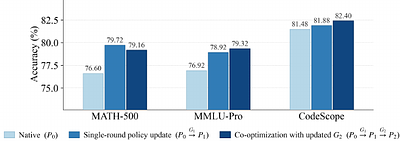
Post-training with evaluator feedback on policy-induced samples serves as a major mechanism for improving large language models. As policies improve, these sampled responses become close in quality. These close candidates create a bottleneck for policy optimization: collapsed relative evaluator score gaps yield weak or misleading policy supervision. We theoretically characterize why these gaps matter through a probability allocation view, showing that the directional gain of shifting probability mass from one response to another is exactly the evaluator score gap between them. This identifies relative score gaps as the policy optimization signals that guide updates. Motivated by this view, we propose DynamicRubric, a response-set-conditioned evaluator--policy co-evolution framework that generates weighted binary rubric items for each candidate set and aggregates the resulting judgments into response-level scores. In our experiments with 8B backbones, DynamicRubric improves evaluator performance and provides stronger policy supervision than baselines using a 70B reward model or a 235B static rubric generator. DynamicRubric-optimized policies also show gains on verifiable reasoning and coding tasks. A DynamicRubric-optimized model is fully deployed in WeChat Search's AI answering scenario, where it serves all online traffic across tens of millions of requests per day and improves key online metrics. These results suggest a principle for evaluator-guided post-training: evaluators should evolve with the policies they supervise. less
By: Andrea Napoli
Correlation alignment and the maximum mean discrepancy are two widely used distribution-matching frameworks for unsupervised domain adaptation (UDA). However, high variance in these losses has been shown to undermine their effectiveness in minibatch optimisation settings. Furthermore, the losses lack finite-sum structure, which renders them incompatible with classical stochastic variance reduction (SVR) methods. This paper proposes Paired Sam... more
Correlation alignment and the maximum mean discrepancy are two widely used distribution-matching frameworks for unsupervised domain adaptation (UDA). However, high variance in these losses has been shown to undermine their effectiveness in minibatch optimisation settings. Furthermore, the losses lack finite-sum structure, which renders them incompatible with classical stochastic variance reduction (SVR) methods. This paper proposes Paired Sampling for Domain Adaptation (PSDA), a novel SVR technique tailored to such objectives. PSDA pairs observations both within and across domains, to form quadruplets that are always sampled together during training. The pairings are designed to minimise expected gradient variance, and reduce to solving a set of linear assignment problems. Our simulations demonstrate reduced variance compared to related methods, and experiments on three domain shift datasets show improved target domain accuracy. less
5 SciCasts by .
By: Amirhossein Sadr, Nima Soltani, Vahideh Moghtadaiee, Aida Pakniyat, Dara Rahmati, Saeid Gorgin
Physics-informed learning of partial differential equations (PDEs) has been dominated by multilayer perceptrons (MLPs), whose spectral bias and dense parameterization limit both accuracy and interpretability. Kolmogorov Arnold Networks (KANs) mitigate these limitations because their learnable spline activations are structurally aligned with the piecewise-polynomial bases of classical discretizations. However, the way a PDE is cast into a loss... more
Physics-informed learning of partial differential equations (PDEs) has been dominated by multilayer perceptrons (MLPs), whose spectral bias and dense parameterization limit both accuracy and interpretability. Kolmogorov Arnold Networks (KANs) mitigate these limitations because their learnable spline activations are structurally aligned with the piecewise-polynomial bases of classical discretizations. However, the way a PDE is cast into a loss functional is as decisive as the choice of approximator: strong-form residual minimization requires high-order derivatives and heavily weighted losses, the energy (Bubnov-Galerkin) form is restricted to self-adjoint operators and, as we show, collapses to a trivial solution for parameter-identification problems, and boundary integral forms require a known fundamental solution. We propose PG-KINN, a physics-informed KAN built on a Petrov-Galerkin formulation in which the trial space is a KAN and the test space is an independent, compactly supported, piecewise-polynomial space evaluated with Gauss-Legendre quadrature. Integration by parts lowers the differentiation order while retaining applicability to general non-self-adjoint, nonlinear, and inverse problems; the localized test functions turn the global residual into a set of element-wise weak residuals with favorable conditioning. On a suite of benchmarks spanning crack singularities, stress concentration, Neo-Hookean hyperelasticity, inverse parameter identification in heterogeneous media, and complex geometries, PG-KINN consistently outperforms legacy MLP baselines and state-of-the-art KAN-based strong/energy/inverse formulations (PIKAN). These results position the Petrov-Galerkin coupling of KAN trial spaces and polynomial test spaces as a robust and accurate route for AI-based computational mechanics. less
By: Jiayi Yang, Yifang Chen, Yuanfu Sun, Jiajin Liu, Qiaoyu Tan
Vision-language models (VLMs) provide a unified representation space for textual and visual information, yet their potential as general-purpose backbones for graph-structured data remains largely unexplored. In practice, attributed graphs exhibit substantial modality heterogeneity: some graphs contain only textual node attributes, others only visual attributes, while still others provide both. Existing graph learning approaches are typically ... more
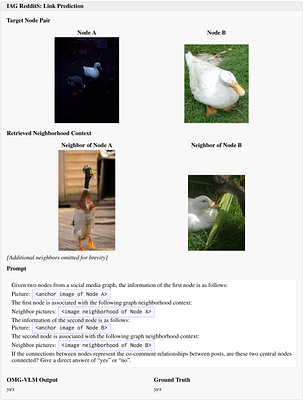
Vision-language models (VLMs) provide a unified representation space for textual and visual information, yet their potential as general-purpose backbones for graph-structured data remains largely unexplored. In practice, attributed graphs exhibit substantial modality heterogeneity: some graphs contain only textual node attributes, others only visual attributes, while still others provide both. Existing graph learning approaches are typically designed for fixed modality schemas, requiring separate models for different settings and limiting scalability and cross-graph generalization. To bridge this gap, we present OMG-VLM (One Model, Many Graphs with Vision-Language Models), a unified framework for learning over attributed graphs across heterogeneous modality schemas. OMG-VLM leverages a pretrained VLM as a shared backbone and introduces structure-aware graph adapters that integrate neighborhood information while remaining compatible with the VLM's native embedding space. This design enables effective learning over text-attributed, image-attributed, and multi-attributed graphs within a single model. Extensive experiments across diverse domains show that OMG-VLM consistently outperforms state-of-the-art GNN- and LLM-based baselines on attributed graph learning tasks such as node classification and link prediction, while exhibiting strong generalization to unseen graphs and varying modality schemas. The source code is available at https://github.com/Jo-eyang/OMG-VLM. less