By: Chee Wei Tan, Yuchen Wang, Shangxin Guo
This paper introduces a new paradigm for AI game programming, leveraging large language models (LLMs) to extend and operationalize Claude Shannon's taxonomy of game-playing machines. Central to this paradigm is Nemobot, an interactive agentic engineering environment that enables users to create, customize, and deploy LLM-powered game agents while actively engaging with AI-driven strategies. The LLM-based chatbot, integrated within Nemobot, de... more
This paper introduces a new paradigm for AI game programming, leveraging large language models (LLMs) to extend and operationalize Claude Shannon's taxonomy of game-playing machines. Central to this paradigm is Nemobot, an interactive agentic engineering environment that enables users to create, customize, and deploy LLM-powered game agents while actively engaging with AI-driven strategies. The LLM-based chatbot, integrated within Nemobot, demonstrates its capabilities across four distinct classes of games. For dictionary-based games, it compresses state-action mappings into efficient, generalized models for rapid adaptability. In rigorously solvable games, it employs mathematical reasoning to compute optimal strategies and generates human-readable explanations for its decisions. For heuristic-based games, it synthesizes strategies by combining insights from classical minimax algorithms (see, e.g., shannon1950chess) with crowd-sourced data. Finally, in learning-based games, it utilizes reinforcement learning with human feedback and self-critique to iteratively refine strategies through trial-and-error and imitation learning. Nemobot amplifies this framework by offering a programmable environment where users can experiment with tool-augmented generation and fine-tuning of strategic game agents. From strategic games to role-playing games, Nemobot demonstrates how AI agents can achieve a form of self-programming by integrating crowdsourced learning and human creativity to iteratively refine their own logic. This represents a step toward the long-term goal of self-programming AI. less
Alignment has a Fantasia Problem
0upvotes
By: Nathanael Jo, Zoe De Simone, Mitchell Gordon, Ashia Wilson
Modern AI assistants are trained to follow instructions, implicitly assuming that users can clearly articulate their goals and the kind of assistance they need. Decades of behavioral research, however, show that people often engage with AI systems before their goals are fully formed. When AI systems treat prompts as complete expressions of intent, they can appear to be useful or convenient, but not necessarily aligned with the users' needs. W... more
Modern AI assistants are trained to follow instructions, implicitly assuming that users can clearly articulate their goals and the kind of assistance they need. Decades of behavioral research, however, show that people often engage with AI systems before their goals are fully formed. When AI systems treat prompts as complete expressions of intent, they can appear to be useful or convenient, but not necessarily aligned with the users' needs. We call these failures Fantasia interactions. We argue that Fantasia interactions demand a rethinking of alignment research: rather than treating users as rational oracles, AI should provide cognitive support by actively helping users form and refine their intent through time. This requires an interdisciplinary approach that bridges machine learning, interface design, and behavioral science. We synthesize insights from these fields to characterize the mechanisms and failures of Fantasia interactions. We then show why existing interventions are insufficient, and propose a research agenda for designing and evaluating AI systems that better help humans navigate uncertainty in their tasks. less
By: Natan Levy, Gadi Perl
Artificial intelligence now decides who receives a loan, who is flagged for criminal investigation, and whether an autonomous vehicle brakes in time. Governments have responded: the EU AI Act, the NIST Risk Management Framework, and the Council of Europe Convention all demand that high-risk systems demonstrate safety before deployment. Yet beneath this regulatory consensus lies a critical vacuum: none specifies what ``acceptable risk'' means ... more
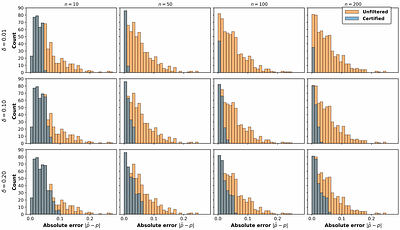
Artificial intelligence now decides who receives a loan, who is flagged for criminal investigation, and whether an autonomous vehicle brakes in time. Governments have responded: the EU AI Act, the NIST Risk Management Framework, and the Council of Europe Convention all demand that high-risk systems demonstrate safety before deployment. Yet beneath this regulatory consensus lies a critical vacuum: none specifies what ``acceptable risk'' means in quantitative terms, and none provides a technical method for verifying that a deployed system actually meets such a threshold. The regulatory architecture is in place; the verification instrument is not. This gap is not theoretical. As the EU AI Act moves into full enforcement, developers face mandatory conformity assessments without established methodologies for producing quantitative safety evidence - and the systems most in need of oversight are opaque statistical inference engines that resist white-box scrutiny. This paper provides the missing instrument. Drawing on the aviation certification paradigm, we propose a two-stage framework that transforms AI risk regulation into engineering practice. In Stage One, a competent authority formally fixes an acceptable failure probability $δ$ and an operational input domain $\varepsilon$ - a normative act with direct civil liability implications. In Stage Two, the RoMA and gRoMA statistical verification tools compute a definitive, auditable upper bound on the system's true failure rate, requiring no access to model internals and scaling to arbitrary architectures. We demonstrate how this certificate satisfies existing regulatory obligations, shifts accountability upstream to developers, and integrates with the legal frameworks that exist today. less
8 SciCasts by .