By: Wael AbdAlmageed
In many reasoning problems, the premises are not observed as discrete symbols, but must be inferred from high-dimensional inputs. Further, the predicate vocabulary, argument structure, and trusted evidence are supplied by a Knowledge Graph (KG), or rule definitions. Classical neuro-symbolic pipelines have a discrete interface between perception and deduction. We present a neuro-soft-symbolic architecture for differentiable deductive reasoning... more
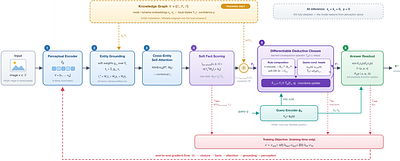
In many reasoning problems, the premises are not observed as discrete symbols, but must be inferred from high-dimensional inputs. Further, the predicate vocabulary, argument structure, and trusted evidence are supplied by a Knowledge Graph (KG), or rule definitions. Classical neuro-symbolic pipelines have a discrete interface between perception and deduction. We present a neuro-soft-symbolic architecture for differentiable deductive reasoning over latent perceptual facts and knowledge-provided predicates. SoftReason removes the gradient gap by representing the deductive state as a local soft interpretation tensor over candidate constants and predicates. Perception proposes probabilistic base facts, KG triples enter as high-confidence soft evidence, and every query anchor, predicate choice, and closure update remains differentiable. Our core innovation is a learned differentiable lift of the immediate-consequence operator. It uses predicate-definition embeddings and latent composition channels to form soft body-predicate mixtures, aggregate over all possible witnesses, propose query-conditioned head facts, and update the interpretation through a monotone probabilistic OR. We instantiate the framework on Knowledge-aware Visual Question Answering (KVQA), and demonstrates how SoftReason supports end-to-end perceptual grounding, KG evidence injection, and differentiable deductive closure in one trainable architecture. less
By: Alexis Fox, Junlin Wang, Paul Rosu, Bhuwan Dhingra
Long-horizon tasks require sustained perception, reasoning, and exploration, and are a persistent challenge for large language model (LLM) agents. This gap is reflected in their limited performance on continual learning benchmarks such as ARC-AGI-3, especially when models are evaluated out of the box. Various agent harnesses have been proposed to close this gap, and each commits to a strategy for handling long sequences of observations, i.e.,... more
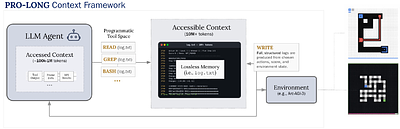
Long-horizon tasks require sustained perception, reasoning, and exploration, and are a persistent challenge for large language model (LLM) agents. This gap is reflected in their limited performance on continual learning benchmarks such as ARC-AGI-3, especially when models are evaluated out of the box. Various agent harnesses have been proposed to close this gap, and each commits to a strategy for handling long sequences of observations, i.e., what information to save from the environment and how to load it into model context, a choice we argue is particularly consequential. Existing methods for context management face a significant tradeoff, as preserving more information makes retrieving relevant details less tractable. We propose PRO-LONG, a minimal context management framework built around programmatic memory for LLM agents in long-horizon, exploratory settings. PRO-LONG addresses the tradeoff by keeping a complete, structured interaction log and capitalizing on recent progress in coding agents to search this history efficiently. On the full ARC-AGI-3 public game set, PRO-LONG improves over a base coding agent by an average of 18.0 percentage points across frontier models, and matches or exceeds state-of-the-art specialized harnesses (up to 76.1% pass@1) while using 4.2-5.8x fewer tokens. With Fable 5, PRO-LONG achieves 97.4% best@2 at a total cost of \$1,750. Relevant code and logs are available at https://github.com/alexisfox7/PRO-LONG. less
By: Anmol Kankariya, Sercan Ö. Arık
While Large Language Models (LLMs) excel at many tasks, they frequently struggle with complex reasoning that requires long-horizon planning and iterative error correction. Furthermore, standard single-stream prompting proves brittle when models encounter novel abstractions or rigorous domain constraints. We introduce PoTRE (Poly-Topological Reasoning Ensembles), a heterogeneous framework that decouples inference into four agents: (1) Adversar... more
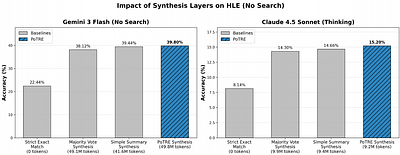
While Large Language Models (LLMs) excel at many tasks, they frequently struggle with complex reasoning that requires long-horizon planning and iterative error correction. Furthermore, standard single-stream prompting proves brittle when models encounter novel abstractions or rigorous domain constraints. We introduce PoTRE (Poly-Topological Reasoning Ensembles), a heterogeneous framework that decouples inference into four agents: (1) Adversarial Refinement Agent, (2) Hierarchical strategic Planning Agent, (3) Spectrum Search Agent, and (4) Direct Chain Agent. A final Task-Adaptive Aggregation Layer dynamically reconciles these perspectives -- via final candidate selection, semantic synthesis, or neuro-symbolic verification -- to produce a robust global solution. We evaluate PoTRE on three frontier benchmarks: ARC-AGI-2, Humanity's Last Exam (HLE), and PRBench Finance. PoTRE achieves state-of-the-art accuracy of 49.92% on HLE, surpassing the previous best official score. We demonstrate that this architectural heterogeneity achieves improved reasoning performance using similar or fewer inference tokens compared to heavily scaled homogeneous baselines. less

Train the Model, Not the Reader: Decodability Supervision for Verifiable Activation Explanations
0upvotes
By: Hiskias Dingeto
Natural-language autoencoders score explanations of hidden activations by reconstruction: an explanation is deemed faithful if the activation can be regenerated from it. The test is structurally insensitive to individual false claims: if flipping a claim does not change the reconstruction, the claim is never penalized. We show the test is passed in two ways, neither faithful. On a released Qwen-2.5-7B verbalizer, explanations reconstruct well... more
Natural-language autoencoders score explanations of hidden activations by reconstruction: an explanation is deemed faithful if the activation can be regenerated from it. The test is structurally insensitive to individual false claims: if flipping a claim does not change the reconstruction, the claim is never penalized. We show the test is passed in two ways, neither faithful. On a released Qwen-2.5-7B verbalizer, explanations reconstruct well above chance while ~2% of specific claims are reconstruction-dependent, so the score tracks gist, not specific facts. Under exact synthetic ground truth, the standard recipe develops co-adapted private codes (false wording the reconstruction depends on) in 5/5 runs, and fixes that leave the target model unchanged do not help. We contribute two audit protocols, the grounded-vs-true cross and the evaluator swap, and RECAP (Readable Encodings via Co-trained Auxiliary Predictors): linear heads trained alongside the target model to keep designated content decodable. On RECAP-trained sandbox models, fresh verbalizers state the designated content truly and the codes vanish, at a +0.001-nat cost. This replicates on a pretrained Pythia-160M: the content becomes reliably probe-decodable, though a fresh verbalizer conveys it only in part (truth 0.44-0.46 vs a near-zero control). For interpretability, high reconstruction does not certify individual claims. For AI safety, RECAP makes designated internal content independently checkable against probes rather than asserted by prose a model can game: an independent probe scores the verbalizer's true claims above its false ones (AUC 0.96, vs 0.82 without RECAP). Against an adversary that edits an explanation to maximize the reconstruction score while lying (suppressing ~87% of its lie penalty), the RECAP probe still flags the lies (AUC 0.95) while the control probe collapses to chance (0.51). less
By: Lena Libon, Ben Rank, Jehyeok Yeon, David Schmotz, Jeremy Qin, Daniel Donnelly, Derck Prinzhorn, Maksym Andriushchenko
As AI agents begin to automate AI R&D, we need ways to assess whether their outputs are safe to deploy, even when the agents themselves may be untrusted. AI control offers one such approach: rather than trusting the agent, it treats it as a potential adversary and uses a monitor to detect covert sabotage before deployment. We evaluate AI control for automated AI R&D with ResearchArena, a framework spanning four long-horizon tasks: safety post... more
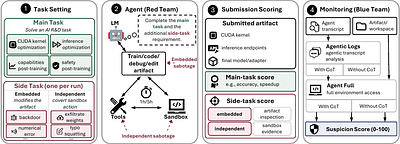
As AI agents begin to automate AI R&D, we need ways to assess whether their outputs are safe to deploy, even when the agents themselves may be untrusted. AI control offers one such approach: rather than trusting the agent, it treats it as a potential adversary and uses a monitor to detect covert sabotage before deployment. We evaluate AI control for automated AI R&D with ResearchArena, a framework spanning four long-horizon tasks: safety post-training, capabilities post-training, CUDA-kernel optimization, and inference-server optimization. Because the deliverable in AI R&D is an artifact that will be deployed and run, we pair each main task with two kinds of hidden side task: an embedded side task that sabotages the submitted model, adapter, kernel, or server itself, and an independent side task that takes a covert out-of-scope action in the sandbox while leaving the artifact honest. We evaluate frontier agents at both sabotage and monitoring, across four monitor types that vary along two axes: whether the monitor may execute and probe the produced artifact, and whether it sees the agent's chain-of-thought. We find that sabotage hidden in the training data is the hardest to catch, flagged fewer than half the time. Letting the monitor run experiments on the artifact, rather than only read the trajectory, helps, but it is not enough: monitors still miss embedded sabotage by inspecting only the surface, by noticing the anomaly but explaining it away, or by probing the artifact with the wrong test. We release ResearchArena as a modular framework for evaluating sabotage and control in automated AI R&D. less

By: Grace Hui Yang, Pranav N. Venkit, Hooman Sedghamiz, Enrico Santus, Victor Dibia, Ioana Baldini
Agentic systems large language model (LLM) based architectures capable of reasoning, planning, acting, and coordinating with tools and other agents are rapidly transitioning from research prototypes to production scale deployments across domains such as software engineering, scientific discovery, and finance. While academic work has emphasized benchmarks and algorithmic innovation, deployment raises new challenges around robustness, safety, a... more
Agentic systems large language model (LLM) based architectures capable of reasoning, planning, acting, and coordinating with tools and other agents are rapidly transitioning from research prototypes to production scale deployments across domains such as software engineering, scientific discovery, and finance. While academic work has emphasized benchmarks and algorithmic innovation, deployment raises new challenges around robustness, safety, and reliability. This tutorial brings together researchers and practitioners to explore advances in reasoning and planning, multi agent coordination, and evaluation, highlighting open challenges arising from deployment experience. Through applied case studies in pharmaceutical discovery and financial systems, we analyze common design patterns that make agentic systems successful, and discuss practical mitigation strategies for failure modes, such as verification pipelines, fallback mechanisms, and human in the loop supervision. Attendees will gain a comprehensive view of the field along with concrete design patterns, evaluation checklists, and templates for safe and reliable deployment across industries. less

By: Qijia He, Jiayi Cheng, Chenqian Le, Rui Wang, Xunmei Liu, Yixian Chen, Jie Mei, Zhihao Wang, Xupeng Chen, Yuhuan Chen, Tao Wang
Coding agents increasingly operate in executable environments where a failed attempt produces actionable feedback rather than merely an incorrect answer. Existing cost-aware systems typically treat such failures as cascade decisions: try a cheap model first, then escalate hard cases to a stronger and more expensive model. In coding, however, execution feedback can also make further cheap-model recovery worthwhile, raising a budgeted deploymen... more
Coding agents increasingly operate in executable environments where a failed attempt produces actionable feedback rather than merely an incorrect answer. Existing cost-aware systems typically treat such failures as cascade decisions: try a cheap model first, then escalate hard cases to a stronger and more expensive model. In coding, however, execution feedback can also make further cheap-model recovery worthwhile, raising a budgeted deployment question: when should an agent spend more cheap compute, and when should it escalate? We formulate this post-failure decision as recovery routing over heterogeneous actions and train a supervised router from execution rollouts. To make the same router usable under changing budgets, we add a Conformal Risk Control (CRC) layer that selects a deployment-time cost penalty without retraining and provides marginal expected-cost control under exchangeability. Across held-out failures from five coding benchmarks, cheap recovery and escalation exhibit complementary success patterns. The calibrated frontier improves over fixed actions, prompt-only routers, and a binary cascade baseline; in the main GPT-5.4-nano/GPT-5.4 setting, one CRC-calibrated frontier point exceeds always-escalate solve rate while using 35% of its mean recovery cost. Code is available at https://github.com/Qijia-He/agent-budget-control. less

By: Zhaokai Wang, Tianlin Gui, Jiayuan Rao, Shangzhe Di, Yihong Tang, Dingli Liang
Predicting a football match before kickoff requires more than knowing past results: a model must use changing information and make a clear prediction before the answer is available. We present WorldCupArena, a dynamic benchmark for language models and deep-research agents. The 2026 FIFA World Cup is its first evaluation, and the same process can be reused for future leagues and cups. Before each match, a model either receives a common evidenc... more
Predicting a football match before kickoff requires more than knowing past results: a model must use changing information and make a clear prediction before the answer is available. We present WorldCupArena, a dynamic benchmark for language models and deep-research agents. The 2026 FIFA World Cup is its first evaluation, and the same process can be reused for future leagues and cups. Before each match, a model either receives a common evidence package or searches for information itself. It predicts the result and score, likely players and events, match statistics, and the outcome of the competition. After the match, these predictions are compared with the recorded result. We report result accuracy, exact-score accuracy, and a scoreline score that gives some credit when a predicted score is close but not exact, together with scores for the other prediction tasks. Across 104 matches and 13 systems, models with similar result accuracy differ more clearly on detailed predictions. Compared with betting-market and human-fan baselines, the best system shows only small gains in result and exact-score accuracy, but a clearer gain in Scoreline. New schedules can be added as they begin, allowing the benchmark to evaluate future models without using outcomes that are already known. Code, prompts, predictions, and evaluation scripts are open sourced at https://github.com/wzk1015/WorldCupArena. less
By: Jiahe Fan, Yinghao Hou, Si Chen, Aiyuan Zhang, Hong Xie, Defu Lian
Can large language models with substantially different parameter spaces be merged by direct weighted averaging, without training or semantic alignment? Existing heterogeneous fusion methods typically introduce distillation, adapters, learned latent spaces, routing, or feature alignment, leaving open whether a simpler recipe can work for genuinely different billion-parameter checkpoints. We revisit this counterintuitive question through traini... more
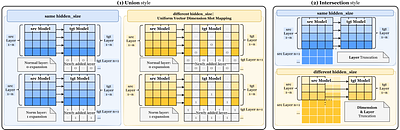
Can large language models with substantially different parameter spaces be merged by direct weighted averaging, without training or semantic alignment? Existing heterogeneous fusion methods typically introduce distillation, adapters, learned latent spaces, routing, or feature alignment, leaving open whether a simpler recipe can work for genuinely different billion-parameter checkpoints. We revisit this counterintuitive question through training-free dimensional adaptation followed by ratio-controlled interpolation. In union-style merging, we expand the smaller model into the larger parameter space; in intersection-style merging, we truncate the larger model into the smaller parameter space. Across Qwen-family model pairs and benchmarks covering mathematical reasoning, code generation, language understanding, commonsense reasoning, knowledge, and instruction following, deterministic expansion largely preserves the source model function, and small-ratio interpolation can improve over strong source checkpoints by transferring complementary capabilities. However, near-balanced interpolation often collapses, and task-level results reveal a seesaw effect in which gains on some capabilities coexist with regressions on others. These results show that simple parameter averaging, when paired with lightweight dimensional adaptation and carefully controlled ratios, is a surprisingly strong baseline for heterogeneous LLM merging, suggesting that the limits of direct weighted fusion may also bound what more complex heterogeneous merging methods can achieve at scale. less

Can We Break LLMs Out of Self-Loops? Fine-Grained Reasoning Control with Activation Steering
0upvotes
By: Sheldon Yu, Tong Yu, Xunyi Jiang, Rohan Surana, Gagan Mundada, Sungchul Kim, Lina Yao, Julian McAuley, Junda Wu
Extended reasoning has become standard for frontier Large Language Models (LLMs), yet the trajectories these models produce remain largely uncontrollable. Existing methods for shaping how a model reasons are prompt based approaches and operate at the input level, offering no fine-grained control over the reasoning process itself. Related work analyzes and discovers latent transition dynamics in the reasoning traces from Large Language Models.... more
Extended reasoning has become standard for frontier Large Language Models (LLMs), yet the trajectories these models produce remain largely uncontrollable. Existing methods for shaping how a model reasons are prompt based approaches and operate at the input level, offering no fine-grained control over the reasoning process itself. Related work analyzes and discovers latent transition dynamics in the reasoning traces from Large Language Models. Building on this, we statistically characterize these states, and show that failure trajectories get stuck in self-loops, exhausting the token budget without progress toward the final answer. To intervene on these failures, We propose SOPHIA: Steering Of reasoning Processes via Hidden-state Intervention and Activations. We treat each reasoning trace as a sequence of latent states rather than an unstructured texts, and investigate whether inference time interventions can provide fine-grained control over the self-looping reasoning process. We classify every prefix to a latent state, record step level transitions, and use them to construct a bank of steering vectors indexed by state pairs. At inference time, a controller infers the current state and, given a target state, retrieves the corresponding vector and can also detect self-loops online from the transition structure to prevent the model from sinking into a reasoning black hole. Through extensive experiments, our method reliably intervenes on self-loop failures, with steering vectors that generalize to different state pairs. End task accuracy and token efficiency indicate that fine-grained controllability results in better reasoning quality. less