TGFβ determines epithelial tissue spacing by regulating mesenchymal condensation

TGFβ determines epithelial tissue spacing by regulating mesenchymal condensation
Park, C. J.; Zhang, P.; Trenado-Yuste, C.; Nelson, C. M.
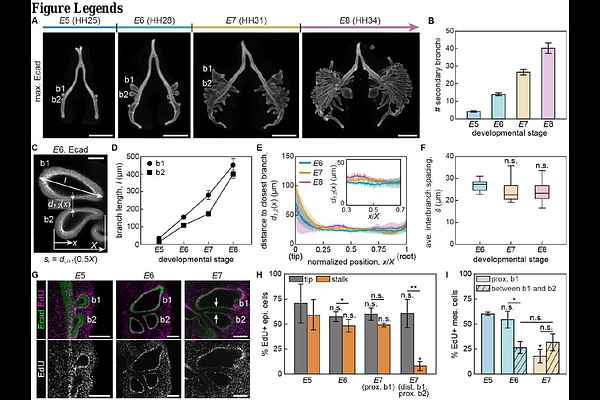
AbstractThe branched structure of the vertebrate lung provides a high surface area-to-volume ratio, which increases the efficiency of diffusion-driven gas exchange. Generating this structure requires that the epithelial branches avoid contacting each other as they elongate during development. Previous studies have suggested that the spacing between neighboring branches is intrinsic to growth of the epithelium, but the underlying physical mechanisms remain elusive. Here, we used the embryonic chicken lung as a model system and found that branch spacing is regulated primarily by signaling to the mesenchyme through transforming growth factor-beta (TGF{beta}). Although proliferation decreases in epithelial cells that are located in close proximity to an adjacent branch, these patterns surprisingly emerge after regular branch spacing has been established. Instead, we find that TGF{beta} promotes the directed migration of mesenchymal cells, which form a condensation that physically displaces the adjacent epithelium and tunes branch spacing. Continuous disruption of TGF{beta} signaling prevents mesenchymal condensation and eventually results in contact between adjacent branches. These data suggest that the spacing between epithelial branches results from mesenchymal cell dynamics rather than from epithelial-intrinsic self-avoidance.