A Csf1r lineage gives rise to dermal lymphatic endothelial cells

A Csf1r lineage gives rise to dermal lymphatic endothelial cells
Canu, G.; Correra, R.; Plein, A. R.; Denti, L.; Fantin, A.; Ruhrberg, C.
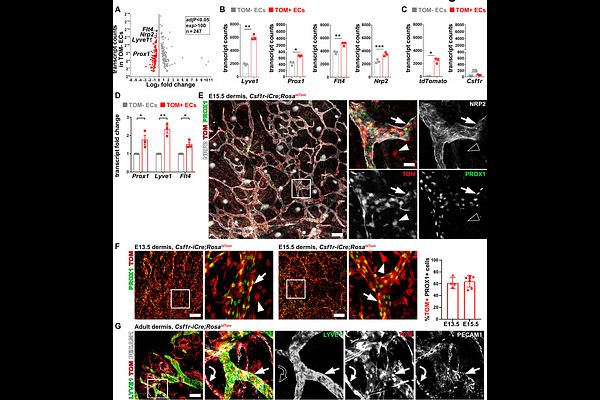
AbstractLymphatic vessels are formed during embryonic and postnatal development to facilitate interstitial fluid clearance and immune regulation after birth. Their organ-specific heterogeneity in organisation and function is preceded by heterogenous origins of lymphatic endothelial cells (LECs), the main building blocks of lymphatic vessels. In the dermis, a subset of LECs was reported to arise from blood capillaries, which themselves differentiate, in part, from paraxial mesoderm. However, it is not known whether additional cell lineages contribute to the dermal LEC population. Here, we have combined transcriptomic analyses with genetic lineage tracing and wholemount immunostaining to show that 60% of LECs in the embryonic day (E) 13.5 and E15.5 dermis are derived from a cell lineage that expresses Csf1r, a marker of myeloid cells and their progeny. Csf1r lineage LECs persist in adult dermal lymphatic vasculature and are indispensable for normal lymphatic development, because Prox1 deletion within the Csf1r lineage causes dermal oedema and blood-filled lymphatic vessels. As Csf1r lineage dermal LECs do not themselves express Csf1r and also do not arise from Csf1r-expressing differentiated myeloid cells, our findings imply the existence of a Csf1r-expressing non-LEC precursor population for the majority of dermal LECs and will prompt further work to identify this cell population.