Spatial control of mitochondrial retrograde signaling by nuclear pore-associated contact sites

Spatial control of mitochondrial retrograde signaling by nuclear pore-associated contact sites
Mitra, S.; Burrone, G.; Rubarajan, S.; Klein, C.; Kwok, T.; Gutta, S.; Li, K.; Berson, E.; Orofino, J.; Cardamone, M. D.; Blower, M. D.; Perissi, V.
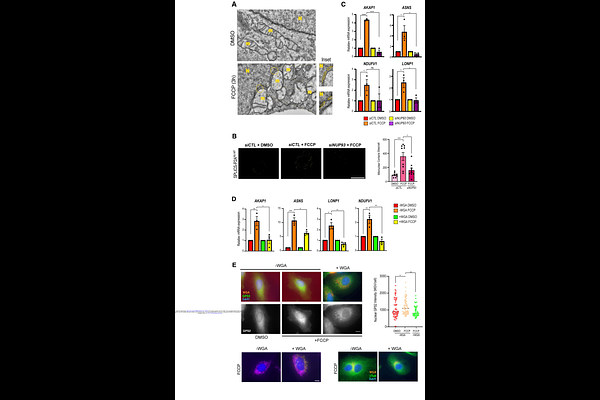
AbstractMitochondria relay their functional state to the nucleus via retrograde signaling, yet whether the spatial organization of the mitochondrial network plays a role in this process remains unclear. Here, we show that stress-induced clustering of mitochondria around the nucleus is a crucial part of the retrograde response. Perinuclear clustering facilitates the formation of mitochondria-nucleus contact sites (MNCS) and the nuclear entry of GPS2, a key mediator of mitochondrial retrograde signaling essential for activating nuclear-encoded mitochondrial and stress-response genes in response to various mitochondrial stressors. Unexpectedly, TSPO-driven MNCS are dispensable for GPS2-based retrograde signaling. Instead, we identify the mitochondrial import receptor TOMM70 and the nucleoporin RanBP2/NUP358 as components of a stress-induced nuclear pore-associated tethering complex required for promoting GPS2 nuclear translocation and activation of downstream programs. These findings establish MNCS as a functional gateway for mitochondrial retrograde signaling, highlighting that organelle positioning and tethering at the nuclear pore provide an unexpected layer of stress regulation.